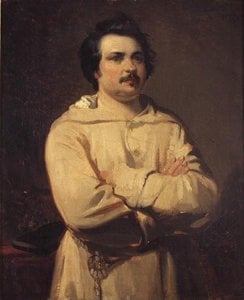
Louis Boulanger : Un Visionnaire Romantique
Louis Boulanger (1806 – 1867) s'impose comme une figure de proue de la peinture romantique française, un artiste dont les toiles dramatiques ont capturé l'esprit de son époque et ancré sa place dans le paysage artistique du Paris du milieu du XIXe siècle. Né à Paris, les années de formation de Boulanger furent imprégnées d'un enseignement classique — il s'inscrivit à l'École des Beaux-Arts où il perfectiona ses compétences sous la direction de Guillaume Guillon Lethière — un socle qui allait profondément façonner son style et sa sensibilité artistiques. Cette approche disciplinée contrastait nettement avec la ferveur émotionnelle naissante du Romantisme, pourtant Boulanger sut marier avec brio tradition et innovation pour produire des œuvres imprégnées à la fois de grandeur et de profondeur psychologique.- Influences précoces et formation : L'éducation de Boulanger lui a inculqué une attention méticuleuse aux détails et une compréhension de la précision anatomique, des traits manifestes dans l'ensemble de son œuvre. Il admirait particulièrement les œuvres d'Ingres, dont l'idéalisme classique servit de principe directeur aux ambitions artistiques de Boulanger.
- <Le Prix de Rome et Eugène Devéria : Reconnaissant son talent, Boulanger obtint le prestigieux prix de Rome en 1824, ce qui lui permit de voyager abondamment à travers l'Italie et de s'immerger dans l'héritage artistique de l'Antiquité. Sa collaboration avec Eugène Devéria favorisa les échanges intellectuels et élargit ses horizons artistiques, influençant ainsi ses choix stylistiques.
Un cercle romantique parisien et le récit dramatique
La carrière artistique de Boulanger s'épanouit au sein du vibrant cercle romantique parisien — un milieu caractérisé par des débats passionnés sur l'art et la littérature, alimentés par les bouleversements politiques et les réformes sociales. Il se lia d'amitié avec Victor Hugo ainsi qu'avec de nombreux autres écrivains et artistes qui prônaient l'expression de l'émotion et le récit imaginaire. Cet environnement impacta indéniablement la vision artistique de Boulanger, l'encourageant à privilégier la narration dramatique et la composition théâtrale. Ses peintures dépeignaient fréquemment des événements historiques avec une intensité viscérale, transmettant les tourments émotionnels de l'époque — véritable marque de fabrique de l'esthétique romantique.- Succès au Salon et reconnaissance : Boulanger connut un succès considérable lors des expositions du Salon de 1827 et 1831, obtenant notamment une médaille pour « La naissance d’Henri IV » aux côtés de la toile monumentale de Devéria. Ces réussites le propulsèrent au premier plan de la communauté artistique et consolidèrent sa réputation de conteur magistral.
- <Peintures notables : Parmi les œuvres les plus célèbres de Boulanger figurent « Mazeppa », une représentation poignante du poème épique de Mickiewicz, illustrant sa capacité à transmettre l'héroïsme et le pathos ; « La mort de Sardanapale », un effort collaboratif avec Delacroix qui capture l'horreur et la grandeur des guerres napoléoniennes ; et son « Portrait d’Honoré de Balzac », une représentation emblématique de Balzac rendue avec une précision exquise — témoignage de la prouesse technique et de la sensibilité artistique de Boulanger.
Illustrations et style artistique : Visions fantastiques
Au-delà de ses peintures sur chevalet, Boulanger se distingua comme un illustrateur prolifique, collaborant notamment avec Victor Hugo et Alexandre Dumas pour des adaptations littéraires. Ses lithographies — en particulier « La ronde du sabbat » — adoptèrent une approche stylistique distinctive caractérisée par une imagerie fantastique et une atmosphère troublante, une tendance reflétant les angoisses de la période romantique. La technique méticuleuse de Boulanger — caractérisée par des coups de pinceau fluides et des gradations tonales subtiles — créait des toiles imprégnées de luminosité et de résonance émotionnelle. Il employa avec maestria le clair-obscur pour intensifier l'impact dramatique, accentuant les contrastes entre ombre et lumière pour exprimer une complexité psychologique profonde.Héritage et importance historique
La contribution de Louis Boulanger à la peinture romantique française demeure significative par son portrait sans concession de l'émotion humaine et son exécution magistrale. Ses toiles continuent d'inspirer l'admiration par leur grandeur, leur dynamisme et leur profondeur psychologique — des qualités qui résonnent puissamment auprès du public contemporain. De plus, l'association de Boulanger avec des géants de la littérature tels que Hugo a consolidé sa place dans l'histoire culturelle de la France du XIXe siècle, garantissant que son héritage artistique perdure comme un symbole de l'idéalisme romantique et de la narration dramatique. Son œuvre est fièrement conservée dans des institutions telles que le Saint Louis Art Museum et la Maison Victor Hugo, assurant ainsi son accessibilité aux générations futures désireuses d'apprécier la beauté et la puissance éternelles de l'art romantique.Questions et réponses
Où trouver les œuvres de Louis Boulanger classées par couleur ?
L'Index spectral de Louis Boulanger est une page qui organise les œuvres de l'artiste par couleur.
Où peut-on trouver les œuvres de Louis Boulanger regroupées par technique ?
La page Tous les médiums regroupe les œuvres de Louis Boulanger par technique.
Où puis-je admirer les œuvres de Louis Boulanger dans une galerie en 3D ?
Les œuvres de Louis Boulanger sont visibles dans une galerie 3D sur la page Musée 3D de l'artiste.