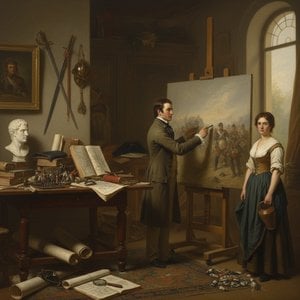
Christian Leopold Bode (1831 – 1906): A Painter of Romantic Detail
Christian Leopold Bode (born March 11, 1831, in Offenbach am Main; died July 26, 1906, in Frankfurt am Main) was a German historical painter and graphic artist who achieved renown for his meticulous renderings of 19th-century life and interiors—particularly those imbued with the spirit of Romanticism. He belonged to a prominent artistic lineage, being the eldest son of landscape painter Georg Wilhelm Bode and Anna Maria. From 1848, Bode pursued formal training at the Städel in Frankfurt under the tutelage of Jakob Becker and Johann David Passavant, establishing a foundation for his future artistic endeavors.
A pivotal moment arrived in 1851 when Bode accepted the mentorship of Eduard von Steinle, furthering his artistic education and broadening his stylistic horizons. Shortly thereafter, he married Catharina Elisabeth Geiger (1826–1856), marking the beginning of a familial partnership that would shape his life’s trajectory. Following graduation in 1859, Bode married Catharina's sister Mary Margaret, with whom he established a household and raised three children. His studio resided at the Städel and, notably, within the opulent Schloss Eisenburg in Offenbach—a location that served as an enduring inspiration for countless exterior and interior views captured in his paintings.
Recognizing Bode’s considerable talent and dedication to artistic pursuits, Grand Duke Ernest Louis of Hesse bestowed upon him the honorary title of Professor in 1901, acknowledging his contribution to German art scholarship. Bode passed away peacefully on July 26, 1906, and was laid to rest in the Old Cemetery of Offenbach—a poignant reminder of a life devoted to artistic creation.
Bode’s artistic journey began amidst the fertile soil of Romanticism, inheriting from his father Georg Wilhelm Bode a profound appreciation for capturing the sublime beauty of nature. Influenced by artists like Caspar David Friedrich and Eugène Delacroix, Bode embraced the expressive power of color and light—techniques that would characterize his distinctive style. He diligently documented everyday scenes – bustling marketplaces, aristocratic salons, and rural landscapes – capturing the nuances of light and color with remarkable precision. His meticulous attention to detail—evident in canvases like “Wolfgang Amadeus Mozart as a Boy”—established him as one of the foremost practitioners of Romantic realism.
His artistic output encompassed a diverse range of subjects, reflecting his intellectual curiosity and engagement with contemporary culture. Bode’s portraits skillfully conveyed psychological depth and nuance, capturing the essence of his subjects' personalities. Simultaneously, he explored genre paintings that depicted scenes from domestic life—illuminating aspects of social customs and familial relationships. Furthermore, Bode possessed an undeniable fascination for architectural spaces—particularly castles and palaces—resulting in stunning depictions reflecting grandeur and elegance. Schloss Eisenburg served as a constant source of inspiration, transforming into countless exterior and interior views imbued with his artistic vision.
Bode’s legacy extends beyond the canvases he created; he played a crucial role in shaping German art scholarship during his lifetime. His unwavering commitment to observation and representation—combined with his mastery of technique—solidified his position as a pivotal figure within the Nazarene movement and Romanticism. Bode's works are housed in museums across Germany, including the Bode Museum in Berlin and the Leopold Museum in Vienna, cementing his place within German art history. Moreover, his depictions of Schloss Eisenburg stand as enduring symbols of aristocratic grandeur and artistic vision—a testament to Bode’s ability to transform observation into evocative representations of the human experience.