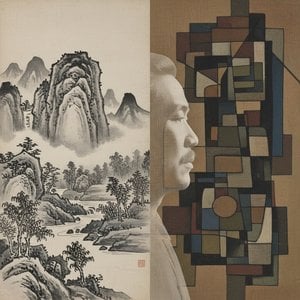
Le Tisseur de Mythe et de Mémoire
Lee Yun-gi (1947–2010) occupait un espace rare dans le paysage culturel coréen, agissant comme un pont entre les profondeurs abyssales de la mythologie antique et les réalités viscérales de l'existence moderne. Né à Gunwi-si, en Corée du Sud, ses premières années furent façonnées par les tensions complexes d'une nation naviguant dans son identité d'après-guerre. Si l'histoire se souvient souvent de lui comme d'un titan de la littérature — un romancier primé et un traducteur prolifique qui a ouvert les labyrinthes complexes d'Umberto Eco aux lecteurs coréens — son âme artistique cherchait une expression à travers un médium plus tactile. Pour Lee, les frontières entre le mot écrit et la toile peinte étaient fluides ; tous deux servaient de réceptacles pour explorer les répercussions psychologiques des conflits, des déplacements et de la puissance durable du lien humain.
Son voyage créatif fut profondément marqué par ses observations durant la guerre du Vietnam, une expérience qui donna naissance à ses débuts littéraires en 1977 avec Hayan Hellikop. Cette première rencontre avec les ombres de la guerre a allumé une préoccupation de toute une vie pour les thèmes du traumatisme et de la survie. En mûrissant, ses horizons intellectuels se sont élargis grâce à des études formelles à l'Université d'État du Michigan, où il s'est immergé dans la littérature comparée et les études religieuses. Cette rigueur académique lui a permis de maîtriser l'art de la traduction, publiant finalement plus de 150 œuvres qui incluaient le poids symbolique et dense des mythes grecs et romains. Cette immersion profonde dans les archétypes classiques a fourni le vocabulaire fondamental de son art visuel, lui permettant d'infuser ses peintures d'un sentiment d'intemporalité et de vérité universelle.
Texture, Symbolisme et Narration Visuelle
Dans sa transition de la précision de la traduction vers la liberté expressive de la peinture, Lee Yun-gi a développé une approche stylistique qui relevait autant de la sensation physique que de la représentation visuelle. Son travail se caractérise par une utilisation remarquable de la texture, où des couches de pigments sont accumulées sur la toile pour créer une profondeur sculpturale et palpable. Cette technique ne se contente pas de dépeindre un sujet ; elle invite le spectateur à ressentir le poids de l'histoire et le grain de la mémoire. Dans des œuvres célébrées telles que Blue-eyed Owl, Lee utilise le symbolisme aviaire — un motif récurrent dans son œuvre — pour évoquer un sentiment de sagesse vigilante et la connexion éthérée entre le terrestre et le divin.
La capacité de l'artiste à fusionner des éléments disparates est peut-être sa plus grande réussite. Ses peintures reflètent souvent la structure de sa prose, utilisant des variations subtiles de couleurs et un impasto épais pour faire progresser un récit sans avoir besoin d'une représentation explicite. Dans des séries telles que la Série des Oiseaux Migrateurs, il explore les thèmes poignants du déracinement et de la quête du foyer, reflétant les mutations socio-politiques de la péninsule coréenne. À travers son usage de l'ombre et de la lumière, Lee crée des paysages qui semblent à la fois intimement personnels et mythiquement vastes, transformant la toile en un espace où la lutte individuelle rencontre l'expérience humaine collective.
Un Héritage de Dialogue Interculturel
La signification historique de Lee Yun-gi réside dans son rôle de médiateur culturel. En traduisant les complexités de la pensée occidentale dans la langue coréenne, puis en traduisant ces mêmes archétypes dans un langage visuel, il a favorisé un dialogue interculturel unique. Son travail résistait au confort facile d'une simple description, optant plutôt pour une utilisation dynamique du dialogue — à la fois littéral dans ses livres et métaphorique dans ses peintures — pour défier et engager son public. Il abordait la vie avec un sens caractéristique de l'optimisme et de l'esprit, refusant de succomber au désespoir de la cruauté humaine, choisissant plutôt de se concentrer sur la résolution des conflits par la créativité.
En fin de compte, l'héritage de Lee Yun-gi est celui d'une synthèse profonde. Il demeure une figure majeure de l'art coréen contemporain car il a réussi à fusionner la précision analytique du chercheur avec la puissance émotive du conteur. L'œuvre de sa vie témoigne de l'idée que, que ce soit par la traduction méticuleuse d'un texte ou par l'application généreuse de peinture sur une toile, le but ultime de l'artiste est de découvrir les vérités universelles qui nous lient tous, à travers le temps et la géographie.
Questions et réponses
Où puis-je voir toutes les œuvres de Lee Yun-Gi ?
Retrouvez toutes les œuvres de Lee Yun-Gi sur ce site en consultant sa page Toutes les œuvres d'art.
Puis-je trier les œuvres de Lee Yun-Gi par couleur ?
La page Par couleur organise les œuvres de Lee Yun-Gi par couleur.
Où trouver les œuvres de Lee Yun-Gi regroupées par mots-clés ?
Explorez les œuvres de Lee Yun-Gi par mot-clé sur la page Par mots-clés de l'artiste. Chaque mot-clé regroupe les œuvres associées.