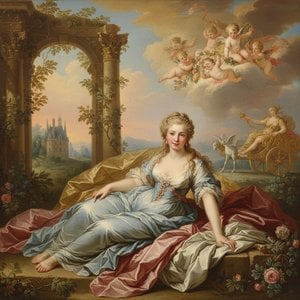
L'Âme d'une Époque : La Vie et l'Héritage de Laurent Dabos
Dans la grande tapisserie de l'histoire de l'art français, peu de peintres ont capturé la transition turbulente entre le crépuscule de la monarchie et l'aube de l'ère napoléonienne avec autant d'éloquence que Laurent Dabos. Né dans la vibrante ville de Toulouse en 1761, Dabos s'est imposé non pas seulement comme un chroniqueur de visages, mais comme un poète visuel des mutations les plus profondes de son temps. Son cheminement vers le cœur de la scène artistique parisienne fut jalonné par une formation classique rigoureuse sous l'égide du respecté François André Vincent, un maître dont l'influence offrit à Dabos une maîtrise de la précision néoclassique. Ce socle lui permit d'allier le dessin discipliné de l'ancien monde à une profondeur émotionnelle naissante qui allait devenir sa marque de fabrique.
L'art de Dabos était profondément lié au personnel et au professionnel. Sa vie créative fut enrichie par son mariage avec Jeanne Bernard, une artiste accomplie à part entière, dont la passion partagée pour la toile créa un sanctuaire domestique dédié à la quinte artistique. Cette synergie de talents renforça probablement sa capacité à naviguer dans les paysages sociaux et politiques complexes de la France de la fin du XVIIIe siècle. En parcourant les expositions prestigieuses de son époque, telles que l'Exposition de la Jeunesse en 1788, Dabos commença à établir une réputation qui transcendait le simple portrait pour tendre vers un style narratif plus profond, capable de porter le poids de l'Histoire elle-même.
Maîtrise du Récit et de l'Émotion
Contempler une œuvre de Laurent Dabos, c'est assister à une leçon magistrale sur l'équilibre entre la grandeur historique et l'intime vulnérabilité humaine. Si sa compétence technique lui permettait de rendre les textures complexes des parures royales et l'acier froid des attributs militaires, c'est sa capacité à capturer l'intériorité psychologique de ses sujets qui le distinguait véritablement. Ses peintures servent souvent de fenêtres sur des moments de transition profonde, où le destin des nations se reflète dans le regard d'un seul individu.
Son œuvre est définie par plusieurs thèmes monumentaux :
- Le Poids de la Monarchie : Dans des œuvres telles que sa représentation de Louis XVI écrivant son testament, Dabos capture l'atmosphère lourde et étouffante d'une ère qui s'achève. Le tableau est moins un manifeste politique qu'une étude de la solitude et de l'anxiété silencieuse d'un homme faisant face à la marée inévitable de la révolution.
- La Poétique du Chagrin : À travers des pièces comme Marie d'Angleterre, Reine de France, pleurant la mort de son époux, Louis XII, Dabos démontre sa capacité à utiliser la composition néoclassique pour élever la douleur personnelle en une expression universelle de perte, utilisant l'ombre et la lumière pour approfondir le sentiment de deuil.
- La Gloire de l'Empire : À l'inverse, Dabos fut capable de pivoter vers l'échelle épique exigée par l'ère napoléonienne. Sa peinture Le Retour de la Grande Armée sert d'hommage dynamique et magistral au triomphe des forces de Napoléon après Waterloo, illustrant sa capacité pour la peinture de genre historique à grande échelle qui célèbre le mouvement, l'énergie et la fierté nationale.
Une Impression Durable sur l'Art Français
La signification de Laurent Dabos réside dans son rôle de pont entre deux mondes. Il se tenait à l'intersection des traditions raffinées et idéalisées du XVIIIe siècle et des sensibilités plus dramatiques et chargées d'émotion qui allaient finalement ouvrir la voie au Romantisme. Son travail ne se contente pas de documenter des événements ; il préserve la température émotionnelle du peuple français durant l'une des périodes les plus transformatrices de l'histoire humaine.
Bien que sa vie s'achève en 1835, la résonance de ses coups de pinceau demeure. En documentant avec une égale révérence les moments intimes des rois et les mouvements impétueux des armées, Dabos a veillé à ce que les émotions fugaces de son temps soient gravées dans la permanence de l'art. Aujourd'hui, son héritage continue d'inspirer ceux qui cherchent à comprendre le cœur humain au milieu du grand théâtre de l'histoire, faisant de ses œuvres des points de repère essentiels pour quiconque étudie l'évolution profonde de la peinture française.
Questions et réponses
Existe-t-il une liste complète des œuvres de Laurent Dabos ?
Chaque œuvre de Laurent Dabos sur ce site web peut être consultée depuis la page Toutes les œuvres de l'artiste.
Puis-je visiter un musée virtuel des œuvres de Laurent Dabos ?
Une visite virtuelle est possible : la page Musée 3D de Laurent Dabos présente les œuvres de l'artiste dans une galerie en trois dimensions.
Dans quels mouvements Laurent Dabos a-t-il travaillé ?
Les œuvres de Laurent Dabos peuvent être consultées par mouvement sur la page Tous les mouvements de l'artiste.