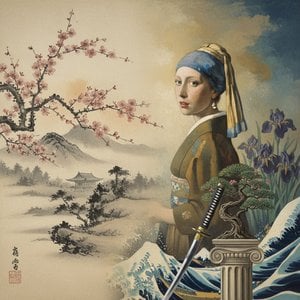
Early Life and Artistic Career
Kishida Ryūsei (岸田劉生), born June 23, 1891, in Osaka, Japan, passed away December 20, 1929, in Tokuyama City, Yamaguchi Prefecture. His formative years were marked by a profound connection to the artistic spirit of his time—the Taishō and Shōwa eras—a period characterized by rapid modernization alongside a fervent revival of traditional Japanese aesthetics. Ryūsei’s father, Kishida Ginkō (1833-1905), was a prominent figure in Osaka's intellectual landscape, serving as a journalist, pharmacist, and champion of Sino-Japanese relations. This upbringing instilled in him a deep appreciation for both Western scholarship and the rich heritage of Japanese culture—a duality that would profoundly shape his artistic vision. Following Ginkō’s untimely death, Ryūsei abandoned his studies at Tokyo Higher Normal School to pursue his lifelong ambition: becoming a painter. He enrolled at Aoibashi Yōga Kenkyūjo (奥伊葉写真懸賞所), established by Hakubakai Society, where he honed his skills under the tutelage of Kuroda Seiki—a pivotal influence who championed the fusion of Western techniques with Japanese sensibilities. This mentorship proved instrumental in shaping Ryūsei’s distinctive style and establishing him as a leading voice within the burgeoning Yōga movement.Artistic Style and Influences
Ryūsei's artistic approach was defined by an unwavering dedication to realism, particularly evident in his yōga portraits—a genre he embraced with remarkable fervor. However, unlike many of his contemporaries who adhered strictly to Western conventions, Ryūsei skillfully integrated elements of Japanese art history into his oeuvre. He drew inspiration from the Impressionists and Post-Impressionists, notably Vincent van Gogh and Paul Cézanne, whose expressive brushstrokes and vibrant palettes resonated deeply with his artistic sensibilities. Simultaneously, he studied Albrecht Dürer’s meticulous detail and Jan van Eyck's masterful use of perspective—techniques that informed his compositional choices and contributed to the profound depth of his paintings. His fascination extended beyond visual aesthetics; Ryūsei was captivated by poetry and literature, mirroring the spirit of the Hakubakai Society, which fostered intellectual discourse and artistic experimentation. This engagement with humanist thought further enriched his artistic worldview and fueled his desire to capture the essence of human experience—a core ambition that permeated throughout his entire oeuvre.Notable Works and Exhibitions
Ryūsei’s artistic legacy rests upon a collection of celebrated paintings that exemplify his stylistic prowess and intellectual curiosity. Among these masterpieces are “Portrait of Reiko with a Doll” (1912), a poignant depiction capturing the innocence and vulnerability of childhood—a motif he revisited repeatedly throughout his career. Equally impressive is “Saeki Yūzō: La Cloche” (1916), commissioned by Yasuda Kasai Museum of Art, which showcases Ryūsei’s masterful command of color and texture—a testament to his ability to translate complex emotions onto canvas. His work graced the walls of numerous exhibitions during his lifetime, cementing his reputation as a respected artist within Japan's artistic community. Notably, he participated in the Fourth Bunten (Ministry of Education Fine Arts Exhibition), where his submissions garnered critical acclaim and solidified his position as one of the era’s foremost talents. Furthermore, Ryūsei’s involvement with Fusain Society—a collective dedicated to promoting Japanese art—provided him with invaluable opportunities for collaboration and artistic dialogue.Historical Significance
Kishida Ryūsei stands as a beacon of innovation within Taishō-period art history—a period marked by turbulent social change and burgeoning Western influence. He bravely navigated this dynamic landscape, forging his own path while simultaneously honoring the traditions of Japanese painting. His distinctive blend of realism and expressive brushwork—informed by both Impressionist and Renaissance precedents—challenged conventional artistic norms and paved the way for future generations of artists. Today, Ryūsei’s paintings reside in prestigious institutions such as Shizuoka Prefectural Museum of Art and Yasuda Kasai Museum of Art, ensuring that his artistic vision continues to inspire admiration and scholarly inquiry—a testament to his enduring contribution to Japanese art heritage.Questions et réponses
Puis-je explorer les œuvres de Kishida Ryūsei par mot-clé ?
La page Par mots-clés de Kishida Ryūsei regroupe les œuvres de l'artiste par mots-clés.
Puis-je parcourir les œuvres de Kishida Ryūsei par ambiance ?
Les œuvres de Kishida Ryūsei peuvent être explorées par émotion sur la page L'espace des émotions de l'artiste, qui organise les créations selon l'ambiance qu'elles dégagent.
Sous quels autres noms ou pseudonymes Kishida Ryūsei est-il connu ?
Kishida Ryūsei est également connu sous le nom de 岸田 劉生.