Kim Ho Deuk: A Journey Through Korean Ink Landscape
Kim Ho Deuk, born in Daegu, South Korea in 1950, stands as a prominent figure in contemporary Korean ink painting—a tradition deeply rooted in Buddhist philosophy and artistic expression. His formative years were marked by rigorous academic pursuits at Seoul National University’s College of Fine Arts, culminating in degrees in both B.F.A. and M.F.A., specializing in painting. This grounding in classical techniques profoundly shaped his artistic vision, informing a lifelong dedication to exploring the profound symbolism inherent within landscape imagery.Early Influences: The Zen Foundation
Ho Deuk’s artistic sensibilities were nurtured by exposure to Zen Buddhism and its emphasis on mindfulness and contemplation—influences that permeate his oeuvre. This philosophical underpinning informs his approach to artmaking, prioritizing inner reflection alongside aesthetic considerations. He consistently sought inspiration from the teachings of Zen masters, recognizing their profound insight into the nature of reality and the human experience. The concept of “now”—a state of pure presence—serves as a guiding principle for his artistic process, mirroring the Zen ideal of achieving enlightenment through mindfulness.Formal Training: Bridging East and West
His studies at Seoul National University provided him with a comprehensive understanding of Western art history alongside Korean painting traditions, fostering a balanced perspective on artistic innovation. This dual influence is evident in his stylistic choices—particularly his masterful use of ink wash technique—which draws upon centuries of Korean artistic heritage while simultaneously engaging with broader aesthetic dialogues. He skillfully blended Eastern and Western influences to create a distinctive visual language that transcends cultural boundaries.Notable Exhibitions: Recognition and Artistic Momentum
Recognizing his talent early on, galleries like Hakgojae and Gallery BK championed his work, showcasing solo exhibitions that garnered critical acclaim and establishing him as a respected artist within Korea’s art community. These presentations solidified his reputation as a visionary innovator—a pioneer of Korean ink landscape painting who captivated audiences with his evocative imagery and intellectual depth. Exhibitions at venues such as Cyan Museum of Art and Ink Studio further amplified his visibility on the international stage, cementing his legacy as one of Korea's most influential artists.The Essence of Korean Ink Landscape Painting
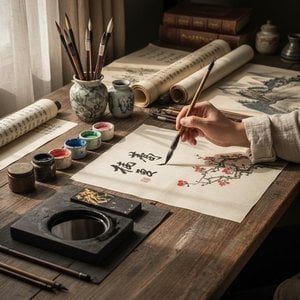
At the core of Kim Ho Deuk’s artistic practice lies the meticulous execution of ink wash painting—a technique characterized by its deliberate simplicity and profound expressive power. Unlike Western landscape paintings that strive for realistic representation, Korean ink landscapes prioritize conveying emotion and spiritual insight rather than visual accuracy. The artist employs subtle gradations of tone achieved through layering washes of ink onto rice paper, creating textures that mimic the natural world while simultaneously embodying concepts of emptiness (sunyata) and interconnectedness—themes central to Buddhist cosmology.Technique: Mastering the Flow
Ho Deuk’s mastery lies in mastering the delicate balance between spontaneity and control—a hallmark of Korean ink painting tradition. He achieves remarkable textural effects through precise brushstrokes and careful manipulation of ink viscosity, capturing the ephemeral beauty of nature with unparalleled subtlety. The artist's technique reflects a deep understanding of material properties and their capacity to convey emotional resonance.Symbolism: Beyond Representation
Recurring motifs such as mountains, trees, and rocks are imbued with symbolic significance, representing permanence, resilience, and the cyclical nature of existence. These images transcend literal depiction—serving instead as conduits for conveying profound philosophical ideas about interconnectedness and transcendence. Each element within his paintings carries a deliberate weight—reflecting the artist’s intention to communicate complex concepts through visual form.Philosophical Resonance: Kosuth's Influence
Like Joseph Kosuth’s “One and Three Chairs,” Kim Ho Deuk’s work engages in a dialogue with philosophical concepts, prompting viewers to consider questions of perception, reality, and the human condition. He seeks not merely to reproduce what is seen but to distill its essence—to capture the underlying spirit of experience itself. This conceptual approach distinguishes him from many contemporary artists—demonstrating an intellectual curiosity that extends beyond purely aesthetic considerations.Legacy: A Continuing Tradition
Kim Ho Deuk’s enduring contribution lies in his ability to transform landscape imagery into vehicles for profound spiritual contemplation—a testament to the transformative power of artistic expression. His work continues to inspire artists and scholars alike—preserving Korean ink painting traditions for future generations while simultaneously engaging with contemporary concerns about identity, culture, and spirituality. He remains a beacon of creativity—a symbol of Korea’s artistic heritage and its commitment to exploring the deepest mysteries of human consciousness.Questions et réponses
Où peut-on trouver les œuvres de Kim Ho Deuk regroupées par technique ?
Pour trouver toutes les œuvres de Kim Ho Deuk dans une technique donnée, consultez la page Tous les médiums de l'artiste.
What other names is Kim Ho Deuk known by?
Kim Ho Deuk is also known as Kim Ho-Deuk.
Comment puis-je voir toutes les œuvres créées par Kim Ho Deuk ?
Chaque œuvre de Kim Ho Deuk sur ce site web peut être consultée depuis la page Toutes les œuvres de l'artiste.
Où puis-je voir la palette de couleurs des œuvres de Kim Ho Deuk ?
Le profil chromatique des œuvres de Kim Ho Deuk est présenté sur la page Génome de la palette de l'artiste.
Puis-je parcourir les œuvres de Kim Ho Deuk par ambiance ?
Les œuvres de Kim Ho Deuk peuvent être parcourues par émotion sur la page L'ambiance par émotion de l'artiste, qui organise les œuvres d'art selon l'ambiance qu'elles dégagent.
Quel est le degré de popularité des œuvres de Kim Ho Deuk ?
Les statistiques relatives aux œuvres de Kim Ho Deuk sont disponibles sur la page Statistiques de l'artiste.
Où et en quelle année Kim Ho Deuk est-il né ?
Kim Ho Deuk est né à Daegu en 1950.
D'où vient Kim Ho Deuk ?
Kim Ho Deuk est né(e) en Corée du Sud.