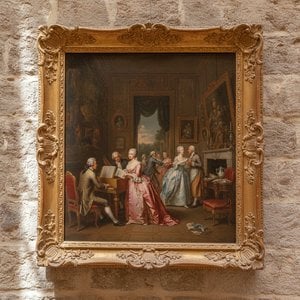
Khariton Platonov: A Portraitist of Innocence and Ukrainian Romanticism
Khariton Platonovich Platonov (1842-1907) stands as a significant figure in late 19th-century Russian genre painting, particularly renowned for his poignant depictions of young women. Born into a peasant family, Platonov’s artistic journey began with formal training at the Imperial Academy of Arts in St. Petersburg where he demonstrated considerable talent and earned prestigious silver medals—a testament to his dedication and skill in drawing. This formative experience instilled within him a profound appreciation for realism and observation, shaping his distinctive style throughout his prolific career. His academic pursuits culminated in titles of Artist, Second Degree and Lecturer at a district school, establishing him as an educator alongside his artistic endeavors. Early exhibitions showcased his burgeoning talent, garnering attention from the Academy’s council and propelling him towards greater recognition. The pivotal gold medal awarded for “Bulgarian Boy” in 1878 solidified his reputation as a masterful painter and cemented his place among the leading artists of his time. This work exemplifies Platonov's ability to convey emotion through subtle nuances of expression and color, capturing the essence of human experience with remarkable sensitivity—a hallmark of Romanticism’s pursuit of emotional truth. Moving to Kiev in 1877, Platonov established himself as a respected teacher at the “Kiev Drawing School,” founded by Nikolay Murashko—a cornerstone institution for nurturing artistic talent in Ukraine. He continued his artistic pursuits alongside his pedagogical role, undertaking the monumental restoration project of St. Cyril’s Church under Mikhail Vrubel's guidance, immersing himself in the grandeur and symbolism of Orthodox iconography. This collaboration underscored Platonov’s commitment to preserving cultural heritage and engaging with broader artistic movements—a reflection of the Zeitgeist of the era. Platonov’s contribution extended beyond individual artworks; he actively championed a more accessible and humanist approach to art education, fostering the development of Ukrainian artists like Mykola Pyomenko and Mykola Burachek who would become celebrated figures in their own right. His unwavering belief in artistic freedom resonated throughout his career, aligning him with the Peredvizhniki movement—a group dedicated to rejecting academic conventions and prioritizing truthful representation of life’s realities. Platonov's legacy resides not only in his captivating canvases but also in his role as a catalyst for artistic innovation and cultural enrichment within Ukraine. His oeuvre comprises numerous evocative paintings, notably “The Little Jewish Girl,” which was purchased by Finance Minister Ivan Vyshnegradsky—a testament to the esteem with which he was held within the cultural circles of his time. Platonov’s works are characterized by meticulous detail, luminous color palettes, and a masterful portrayal of youthful vulnerability—qualities that continue to inspire admiration and scholarly study today. He remains an exemplar of Romantic idealism blended with artistic realism, securing his place as one of Russia's most beloved genre painters.Questions et réponses
Où puis-je admirer les œuvres de Khariton Platonov dans une galerie en 3D ?
La Musée 3D de Khariton Platonov est une page qui présente les œuvres de l'artiste dans une galerie virtuelle en trois dimensions.
Puis-je parcourir les œuvres de Khariton Platonov par palette de couleurs ?
Les œuvres de Khariton Platonov peuvent être parcourues par palette de couleurs sur la page Par palettes de l'artiste.
D'où vient Khariton Platonov ?
Khariton Platonov est né(e) en Russie.