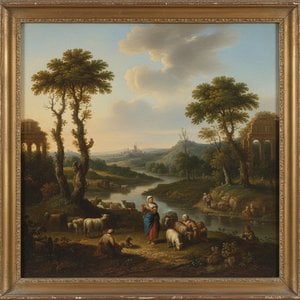
A Vision of Pastoral Beauty: Exploring the Artistry of Ker-Xavier Roussel
Ker-Xavier Roussel (1867 – 1944) stands as a singular figure within the Nabi movement, a collective of French painters who sought to liberate art from academic conventions and embrace Symbolist ideals. Born François Xavier Roussel in lorry-lès-metz, Moselle, his artistic journey began modestly but swiftly gained momentum thanks to formative connections with fellow artists like Édouard Vuillard and Diogène Maillart. These friendships fostered a shared intellectual curiosity and propelled them toward the influential studio of Mauryce Denis, establishing the core of Les Nabis – a group dedicated to capturing fleeting impressions and conveying profound emotional resonance.
Early Influences & Training
Roussel’s formal education at the École des Beaux-Arts in Paris provided him with foundational skills but it was his immersion in Maillart's studio that truly ignited his artistic spirit. Here, he honed his technique and absorbed the stylistic nuances of Impressionism alongside Vuillard and Denis, shaping his distinctive visual language. The meticulous observation of nature—a hallmark of Cézanne’s approach—served as a crucial catalyst for Roussel’s burgeoning talent, prompting him to experiment with innovative compositional strategies and color palettes that would define his artistic style.
The Nabi Aesthetic
Les Nabis championed a rejection of realism, prioritizing atmosphere and emotion over meticulous detail. Roussel’s canvases are characterized by muted palettes—often dominated by blues and greens—that evoke the tranquility of rural landscapes. However, these serene vistas rarely depict empty spaces; instead, they populate them with figures – women, nymphs, and fauns – imbued with mythological symbolism. This deliberate departure from academic tradition reflected a broader cultural shift toward introspection and spiritual contemplation, mirroring the anxieties and aspirations of the era. Roussel’s paintings are infused with a palpable sense of melancholy—a characteristic often attributed to Symbolist painters—yet simultaneously radiate an undeniable optimism rooted in the belief that art could transcend mere representation and communicate profound truths about human experience.
Symbolist Influences & Artistic Vision
Roussel's artistic vision was profoundly impacted by Symbolist thinkers like Gustave Moreau and Edvard Munch, whose explorations of psychological depth and dreamlike imagery resonated deeply within him. He skillfully blended Impressionistic brushwork with Symbolist motifs, creating paintings that are both visually captivating and intellectually stimulating. His fascination with folklore and mythology is evident in works such as “The Garden Of The Hesperides,” where he portrays a classical tale with an understated elegance reminiscent of Renaissance art—a deliberate contrast to the prevailing artistic trends of his time. Roussel’s meticulous attention to detail—particularly in rendering textures and surfaces—demonstrates a commitment to capturing not only visual beauty but also emotional nuance, elevating his paintings beyond mere decorative objects into powerful expressions of inner contemplation.
Notable Works & Legacy
Roussel's oeuvre includes iconic pieces like "Woman In Red In A Landscape" and “Woman in striped dress.” These paintings exemplify his mastery of color and composition, capturing the ethereal beauty of rural scenes with remarkable sensitivity. His work garnered considerable acclaim, culminating in a prestigious Carnegie Prize for Art in 1926—a testament to his unwavering dedication to artistic integrity and a symbol of the enduring power of Symbolism to inspire creativity and provoke contemplation. Ker-Xavier Roussel’s contribution to French art history extends beyond his individual paintings; he represents a pivotal moment in the artistic landscape of the early 20th century, embodying the spirit of Symbolism and advocating for an aesthetic rooted in emotion and imagination. He passed away peacefully in 1944 at his home in l'étang-la-ville, Yvelines, leaving behind a body of work that continues to inspire admiration and contemplation.