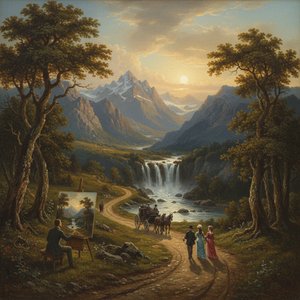
Justinas Vienožinskis: A Pioneer of Lithuanian Landscape Painting
Justinas Vienožinskis (1886-1960) stands as a pivotal figure in Lithuanian art history, recognized primarily for his masterful landscapes and portraits that embody the spirit of the early 20th century. Born in Mataučiūnų kaimas, Rokiskis District, Lithuania, Vienožinskis embarked on an artistic journey marked by rigorous training and unwavering dedication to capturing the beauty of his homeland. His influence extended beyond individual artworks; he established the Kaunas School of Art, shaping generations of Lithuanian artists and fostering a distinctive aesthetic tradition.Early Years & Education
Vienožinskis’s formative years were spent in Moscow where he attended Yukhnevich’s studio gaining foundational knowledge in artistic principles. This initial exposure to Russian art instilled in him a disciplined approach to technique and an appreciation for formal clarity—elements that would become hallmarks of his later work. Subsequently, his studies at the Krakow Academy of Art under T. Axentowich, W. Weiss, J. Pankiewicz and F. Cynk exposed him to European artistic currents, fostering a cosmopolitan outlook that would permeate his oeuvre. He absorbed inspiration from Impressionism and Post-Impressionism, recognizing their ability to convey emotion through color and light—a stylistic choice he consistently pursued throughout his career.European Travels & Artistic Development
During his student days, Vienožinskis undertook extensive travels across Europe – Italy, France, Germany – absorbing inspiration from Impressionism and Post-Impressionism. These experiences profoundly impacted his stylistic choices, evident in the atmospheric perspective and expressive brushwork characteristic of his landscapes. He meticulously observed natural phenomena—the shifting hues of dawn and dusk, the interplay of sunlight on water—translating these visual sensations into canvases imbued with palpable emotion. The influence of artists such as Vincent van Gogh is discernible in Vienožinskis’s bold use of color and textural variation—a deliberate departure from academic conventions that signaled a commitment to artistic innovation.The Kaunas School of Art & Pedagogical Influence
Recognizing the need for formalized artistic education in Lithuania, Vienožinskis founded the High Courses of Drawing in 1920 which evolved into the Kaunas School of Art in 1922. He served as its director until 1924 nurturing a cohort of talented artists who would become prominent figures in Lithuanian art. His pedagogical philosophy centered on fostering creativity and encouraging experimentation—a bold stance for the time that championed artistic freedom and challenged established norms. Vienožinskis instilled in his students a deep appreciation for Lithuanian landscape and folklore, shaping their artistic vision and ensuring that Lithuanian artistic traditions persisted through successive generations.Post-War Career & Artistic Legacy
Following the tumultuous events of 1929, Vienožinskis faced dismissal from the Kaunas School but continued his artistic pursuits establishing a private studio and returning to lecturing at Vilnius Academy of Art and Vilnius Institute of Art furthering his commitment to artistic education. Despite setbacks, he remained steadfast in his dedication to preserving Lithuanian artistic heritage—a testament to his unwavering belief in the transformative power of art. His paintings continue to resonate with viewers today capturing the serene beauty of Lithuania’s natural landscapes and conveying a profound sense of contemplation. Vienožinskis's legacy resides not only in his artworks but also in his enduring influence on Lithuanian art education—a cornerstone of Lithuanian cultural identity.Notable Works & Artistic Style
Vienožinskis’s artistic style is distinguished by its sensitivity to light and color, reflecting the influence of Impressionism and Post-Impressionism. He skillfully rendered landscapes—particularly those depicting Lithuanian lakes and forests—with a remarkable attention to detail and tonal gradation. His portraits conveyed psychological depth and nuance capturing the essence of his subjects with understated elegance. Recurring motifs included serene vistas bathed in golden light and contemplative figures imbued with quiet dignity.- “Cows by the Lake Antanašė” exemplifies Vienožinskis’s ability to convey mood through color and composition—a cornerstone of Lithuanian landscape painting.
- His portraits, such as that of Jonas Marcinkevičius, demonstrate his mastery of capturing human emotion and portraying subjects with remarkable accuracy.