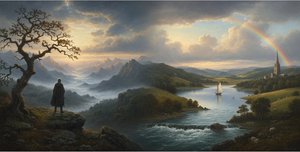
Une vie ancrée dans le paysage écossais
Né à Slateford, Édimbourg, John MacWhirter s'est imposé comme une voix profonde au sein de la peinture de paysage écossaise. Ses premières années furent marquées par une transition du monde du commerce vers la quête des beaux-arts ; après le décès de son père, il effectua brièvement un apprentissage chez les libraires Oliver & Boyd à Édimbourg. Cependant, l'appel de la toile s'avéra irrésystible. En 1851, il s'inscrivit à la Trustees Academy, où il étudia sous la direction de Robert Scott Lauder et John Ballantyne. Cette période formative lui insuffla une profonde révérence pour la nature, le poussant à passer de longues heures à croquer et à étudier le plein air, une pratique qui allait devenir le cœur battant de sa production créative.
Le voyage artistique de MacWhirter fut celui d'une expansion continue, tant géographique que stylistique. Bien que ses racines soient restées fermement plantées dans la campagne vallonnée du Perthshire, sa curiosité le conduisit à parcourir une grande partie de l'Europe et au-delà. Il chercha l'inspiration dans la majesté sauvage des Alpes, les paysages baignés de soleil de l'Italie et de la Sicile, ainsi que dans les panoramas atmosphériques de la Norvège, de la Turquie, et même des États-Unis. Ces voyages enrichirent sa palette et élargirent sa perspective, lui permettant d'apporter une grandeur universelle à ses représentations du monde naturel.
Évolution du style et vision artistique
Le développement de la technique de MacWhirter révèle un artiste en dialogue constant avec les mouvements prédominants de son époque. À ses débuts, il expérimenta le détail méticuleux et l'imagerie vibrante caractéristiques des préraphaélites, influencé de manière significative par les œuvres de John Everett Millais. Pourtant, à mesure que sa carrière mûrissait, il s'éloigna de cette précision rigide pour embrasser un style plus ample et atmosphérique. Cette évolution lui permit de capturer non seulement la forme physique d'un paysage, mais son âme même — la brume s'accrochant à une montagne ou la lumière filtrant à travers une canopée dense d'arbres.
Son œuvre est souvent caractérisée par une sensibilité romantique, particulièrement dans son traitement de la lumière et de la texture. Qu'il peignît un serein canal vénitien avec une touche impressionniste ou qu'il capturât la puissance mélancolique de Mist on the Mountains (Brume sur les montagnes), MacWhirter possédait une capacité unique à évoquer l'émotion par la couleur et le ton. Sa fascination pour les arbres et les textures rugueuses de la campagne devint la marque de fabrique de son œuvre, créant des scènes qui semblaient à la fois intimement liées à la terre et grandiosement cinématographiques.
Héritage et reconnaissance
Tout au long de sa vie, MacWhirter atteignit des étapes professionnelles significatives qui consolidèrent son statut au sein de l'établissement artistique britannique. Son talent fut reconnu très tôt ; à l'âge tendre de 14 ans, il exposa 'Old Cottage at Braid' à la Royal Scottish Academy. Son dévouement à son art lui valut de nombreux honneurs, notamment d'être nommé membre honoraire de la Royal Scottish Academy en 1880, pour finalement être élu Royal Academician en 1893.
Au-delà de ses distinctions individuelles, la contribution de MacWhirter au récit visuel de son temps demeure évidente dans les collections qui abritent ses œuvres. Ses peintures continuent de résider dans des institutions prestigieuses telles que :
- La Tate
- L'Université Royal Holloway de Londres
- The Wilson, Cheltenham
- Les Musées de Derby
Grâce à sa capacité à fusionner le romantisme du paysage avec une maîtrise sophistiquée de la lumière et de l'atmosphère, John MacWhirter a laissé une empreinte indélébile sur la tradition de la peinture de paysage, garantissant que sa vision du monde naturel continue de résonner auprès des spectateurs bien après sa disparition à Londres.
Questions et réponses
À quelle période historique John Macwhirter a-t-il exercé ?
John Macwhirter a œuvré durant la période XIXe siècle. Cette période situe l'activité de l'artiste dans l'histoire.
Puis-je parcourir les œuvres de John Macwhirter par ambiance ?
La L'ambiance par émotion de John Macwhirter est une page qui organise les œuvres de l'artiste par ambiance.
Où et en quelle année John Macwhirter est-il né ?
John Macwhirter est né à Slateford en 1839.