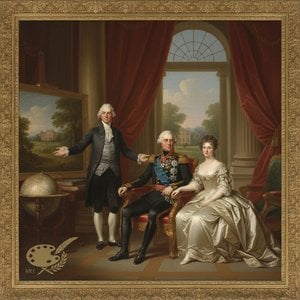
Painting Of Arthur, Prince Of Wales Son Of Henry Vii
En savoir plus…
Art period: Contemporain
Works on APS: 5
Born: 1970, Angleterre
A Life Reclaimed: The Remarkable Story of John Carter
John Carter (1815-1850) was born in Coggeshall, Essex, England, into a family of silk weavers—a profession that would define much of his early life. From childhood, he possessed an innate fascination with sketching, capturing images on paper and even adorning the walls of his home with drawings. However, this quiet artistic inclination took an unexpected turn when tragedy struck in May 1836: a fall from forty feet during an evening spent drinking at the local pub shattered his cervical vertebrae, leaving him paralyzed from the neck down—a devastating blow that would fundamentally alter the course of his existence. Despite the grim prognosis offered by physicians, Carter refused to succumb to despair; instead, he embarked on an extraordinary journey of self-discovery and artistic rebirth.
From Silk Weaver to Master Draftsman
The immediate aftermath of the accident was marked by considerable physical discomfort and reliance on assistance for daily tasks. Yet, amidst these limitations, Carter’s unwavering determination fueled a singular ambition: to regain creative expression through art—a pursuit that defied conventional expectations. Recognizing the inspiring example set by Elizabeth Kinning, an asylum inmate who had mastered drawing with her mouth, Carter meticulously honed his technique using a pencil held firmly between his lips. He painstakingly adapted his workspace and sought guidance from fellow artists like George Richmond, demonstrating remarkable perseverance and ingenuity. His dedication yielded astonishing results—drawings characterized by unparalleled precision and detail that captivated the attention of prominent figures in the medical community and artistic circles alike.
Influences and Artistic Style
Carter’s artistic vision drew heavily upon the legacy of Old Masters such as Albrecht Dürer, Raphael, Rembrandt, Van Dyke, and Landseer – artists whose mastery of technique and sensitivity to light served as guiding principles for his own work. He meticulously copied masterpieces, demonstrating an extraordinary ability to emulate their stylistic nuances and capturing their essence with breathtaking accuracy. However, Carter transcended mere imitation; he also produced original compositions, notably “A Ratcatcher and His Dogs” (1849), which garnered widespread acclaim and secured a prestigious commission from the celebrated animal painter Edwin Landseer—who famously declared it "the finest example of animal drawing he had ever seen." This piece exemplifies Carter’s commitment to realism combined with an exquisite understanding of tonal gradation.
Recognition and Major Achievements
Carter's talent swiftly gained recognition, attracting considerable attention from both medical professionals and fellow artists. His drawings were lauded for their technical brilliance and emotional depth—a testament to his unwavering dedication and artistic skill. Perhaps most notably, Queen Victoria herself acquired a copy of “A Ratcatcher and His Dogs,” cementing Carter’s place in art history as an artist who achieved extraordinary success despite facing profound physical challenges. Furthermore, he created "Our Father Who Art in Heaven" and “Innocence”—inspired by Hermann Winterhalter's composition—demonstrating his mastery of artistic style and capturing the spirit of Victorian England. His legacy extends beyond his individual achievements; Carter embodies the enduring power of creativity to transcend limitations and inspire awe. He remains an important figure in British art history, celebrated not only for *what* he created but also for *how* he achieved it—a triumph of will over adversity that continues to resonate powerfully today.
Par la rédaction de WahooArt.com
Quiz d'art
Chaque question ne comporte qu'une seule bonne réponse.
Question 1:
Quel événement majeur a conduit John Carter à commencer à créer de l'art utilisant sa bouche ?
Question 2:
Avant de devenir artiste, quelle était la profession de John Carter ?
Question 3:
Quel artiste célèbre a commenté le pouvoir extraordinaire de l'imitation dans le travail de Carter ?
Question 4:
Quel était le titre de la peinture originale la plus acclamée de John Carter, même ayant obtenu une copie par la reine Victoria ?
Question 5:
Qu'a provoqué John Carter à se tourner vers la religion après son accident ?', 'choices': [
Plongez dans l'univers de John Constable avec les 25 œuvres incontournables du maître anglais. Découvrez l'histoire, la technique et l'émotion derrière ses paysages romantiques. Reproductions de qualité muséale sur WahooArt.com.
Plongez au cœur du XIXe siècle avec les 10 œuvres incontournables de Manet, Monet et Renoir. Découvrez l'histoire, les techniques et l'émotion derrière ces chefs-d'œuvre impressionnistes et réalistes. Trouvez votre reproduction idéale sur WahooArt.com !
Explore the life & work of John Hoppner, a leading Georgian portraitist. Discover his vibrant style, influential patrons, and lasting impact on British art history. Expert insights for collectors.
Bonjour ! Je peux vous aider à choisir une œuvre d'art, à suivre une commande ou à répondre à vos questions sur la garantie. Comment puis-je vous aider ?