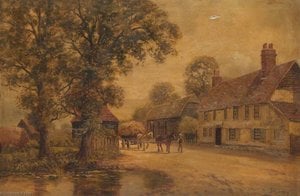
John Bonny: A Painter of English Idols
John Bonny (1874-1948) remains a quietly significant figure in late 19th and early 20th century British landscape painting. Often operating under the pseudonym W. Norris, he cultivated an evocative style deeply rooted in the traditions of the Pre-Raphaelites and the idyllic landscapes favored by artists like Turner and Constable. His work isn’t characterized by grand narratives or dramatic events; instead, Bonny meticulously captured the subtle beauty of rural England – the meandering rivers, the quiet farms, the dappled light filtering through ancient woodlands – creating scenes that feel both familiar and profoundly peaceful.
Born in Cambridge, England, Bonny's early life offered little indication of his future artistic pursuits. He initially studied at St John’s College, Cambridge, but found academic life unfulfilling. It was during this period that he began to seriously engage with art, drawn particularly to the works of the Pre-Raphaelites and their emphasis on naturalism and detailed observation. This influence is readily apparent in his meticulous rendering of textures – the rough bark of trees, the rippling surface of water, the folds of a shepherd’s cloak – all rendered with an almost photographic precision.
The Rivers and Rural Scenes: A Defining Palette
Bonny's most celebrated works depict scenes along the rivers and streams of East Anglia. The River Cam at Weir Hall Ford is perhaps his most iconic painting, capturing a moment of serene beauty as a small boat glides through the water. These paintings aren’t simply representations of landscapes; they are imbued with a sense of nostalgia and longing for a simpler time. He frequently depicted scenes around Tottenham, including Bruce Grove and Rectory Farm, showcasing the evolving landscape of Victorian England alongside its traditional rural elements.
His technique was characterized by a restrained palette – predominantly muted greens, browns, and blues – that perfectly complemented the subdued light of the English countryside. He employed a loose, expressive brushstroke, allowing for subtle variations in tone and texture. Crucially, Bonny wasn’t interested in dramatic sunsets or stormy weather; instead, he sought to capture the quiet dignity of everyday life and the enduring beauty of the natural world. The use of light is particularly noteworthy – often diffused and atmospheric, creating a sense of mystery and tranquility.
Influences and Artistic Connections
While Bonny’s work often appears solitary, it's clear that he was influenced by several key artistic movements and figures. The Pre-Raphaelites, with their emphasis on truth to nature and detailed observation, undoubtedly shaped his approach. Turner’s atmospheric landscapes also served as a significant model, demonstrating the power of light and color to evoke emotion. Interestingly, Bonny's association with W. Norris allowed him to maintain a degree of anonymity during his lifetime, protecting him from some of the more critical assessments that were leveled at other artists of the period.
Furthermore, Bonny’s work reflects a broader cultural shift in England – a growing appreciation for the countryside and a desire to preserve its beauty. The late 19th century witnessed a rise in tourism and leisure activities, leading to increased interest in landscape painting as a means of capturing and celebrating these experiences.
Legacy and Historical Significance
Despite his relatively modest recognition during his lifetime, John Bonny’s work has gained increasing appreciation in recent decades. His paintings are now housed in several important collections, including the Tate Gallery and regional museums across England. Bonny's enduring appeal lies in his ability to transport viewers to a bygone era – a time of rural simplicity, quiet contemplation, and profound connection with nature.
His meticulous attention to detail, combined with his evocative use of light and color, ensures that his paintings continue to resonate with audiences today. John Bonny’s legacy is not one of grand ambition or revolutionary innovation; rather, it's a testament to the power of quiet observation and the enduring beauty of the English countryside – a subtle yet significant contribution to British art history.