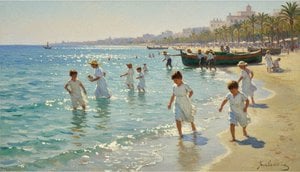
Joaquín Agrasot y Juan: A Pioneer of Costumbrismo
Joaquín Agrasot y Juan (December 24, 1836 – January 8, 1919) stands as a monumental figure in Spanish Realist painting and a cornerstone of the Costumbrismo movement—a stylistic revolution that irrevocably altered the landscape of nineteenth-century art. Born in Orihuela, Alicante Province, Spain, Agrasot’s artistic journey commenced with rigorous training at the Real Academia de Bellas Artes de San Carlos de Valencia, where he immersed himself amongst fellow artists dedicated to upholding academic standards and achieving technical excellence. This formative period instilled within him an unwavering commitment to meticulous observation—a cornerstone of his distinctive style that prioritized capturing the authentic essence of Spanish society.
Early Life & Education: The Seeds of Artistic Passion
Details surrounding Agrasot’s upbringing remain somewhat elusive, yet biographical accounts reveal a childhood nurtured by an innate appreciation for artistic pursuits. His enrollment at San Carlos solidified his determination to master traditional techniques—primarily oil painting—and to translate the subtle nuances of Spanish life onto canvas with unparalleled accuracy. The Academy's curriculum fostered a profound understanding of classical art history and compositional principles, shaping Agrasot’s artistic sensibilities from an early age.
Roman Influences & Artistic Circle: Exposure to Renaissance Grandeur
A pivotal juncture in Agrasot’s artistic development arrived in 1860 when he secured a prestigious fellowship to undertake studies in Rome—a pilgrimage that transported him into the heart of the Italian Renaissance. Surrounded by masterpieces crafted during centuries past, Agrasot absorbed the grandeur and idealism of Florentine art, broadening his artistic horizons beyond the confines of Valencia. He joined the vibrant artistic circle centered at the antico caffè greco, engaging in spirited debates and exchanging ideas with contemporaries who championed realism and expressive brushwork—individuals who recognized the transformative potential of portraying life as it truly existed.
The Costumbrismo Style: Embracing Everyday Life
Agrasot’s artistic vision crystallized into Costumbrismo—a movement deliberately antithetical to academic painting's idealized representations. Unlike its predecessors, Costumbrismo rejected polished surfaces and stylized forms, opting instead for unflinching realism that prioritized honest depictions of landscapes, interiors, and portraits of ordinary Spaniards. Agrasot’s canvases pulsed with vibrant hues and dynamic compositions—a stylistic hallmark reflecting the socio-cultural currents of his time—a period characterized by burgeoning artistic experimentation and a fervent desire to capture the spirit of Spanish identity. His works aimed not merely to depict what was seen but to convey what was felt, conveying the emotional depth inherent in commonplace experiences.
Notable Works & Legacy: A Painter's Enduring Vision
Agrasot’s oeuvre encompasses a remarkable diversity of subjects—from serene landscapes bathed in Andalusian sunlight to intimate portraits capturing fleeting expressions of human emotion. Among his most celebrated paintings are “A Picador on a grey horse,” an evocative depiction of rural Spain imbued with symbolic significance; “Nude,” a masterful exploration of form and gesture that exemplifies Agrasot’s technical prowess; and “Interior with woman embroidering,” which captures the quiet dignity of domestic life. These canvases stand as testament to Agrasot's unwavering dedication to Costumbrismo principles—his ability to transform ordinary scenes into profound meditations on human existence. His legacy resides not only in the beauty of his artworks but also in their enduring portrayal of the human condition—a timeless reminder that art possesses the capacity to illuminate the complexities of daily life and encapsulate the spirit of an era. Agrasot’s influence extended beyond his own artistic creations, shaping the trajectory of Costumbrismo itself and establishing him as a pivotal figure in Spanish art history.