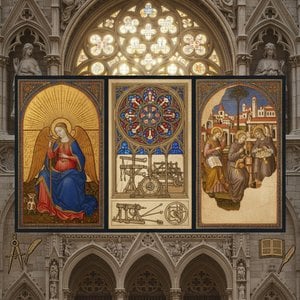
Jean Poyer : A Master of Subtle Renaissance Style
Jean Poyer, born around 1445 in the Netherlands, stands as a singular figure within the artistic landscape of the late medieval and early Renaissance periods—a painter who defied easy categorization and achieved remarkable renown for his distinctive approach to illumination. Unlike many contemporaries preoccupied with grand narratives and monumental compositions, Poyer cultivated a refined aesthetic rooted in meticulous observation and nuanced execution, marking him as an innovator whose legacy continues to fascinate scholars today.
Early Influences and Artistic Formation
Poyer’s formative years coincided with the burgeoning artistic fervor of Tours, France—a city at the crossroads of Burgundian and Florentine influences. The stylistic graces evident in painters like Jan van Eyck and Rogier van der Weyden – characterized by their careful attention to detail, luminous palettes, and a penchant for portraying human figures with astonishing realism – undoubtedly shaped Poyer’s artistic sensibilities. However, his gaze extended beyond the immediate surroundings of Tours; he embarked on expeditions to northern Italy during the 1460s and 1470s, immersing himself in the groundbreaking works of Andrea Mantegna and Giovanni Bellini. These encounters ignited a passion for perspective—a revolutionary technique championed by Filippo Brunelleschi—and instilled in him an unwavering commitment to capturing the essence of human experience with unparalleled accuracy.
The Venetian Connection and Artistic Evolution
The presence of Jean Fouquet, who had introduced Italian stylistic principles into Tours, served as another catalyst for Poyer’s artistic development. Fouquet's masterful use of color and his ability to convey emotion through expressive figures profoundly impacted Poyer’s technique—a shift away from the prevailing Gothic style towards a more luminous and psychologically astute vision. This transformation culminated in Poyer’s mature period (approximately 1490-1503), during which he produced some of his most celebrated illuminated manuscripts, notably the Prayer Book of Anne de Bretagne and the Briçonnet Hours.
Workshop Practice and Collaborative Creativity
Poyer operated within a complex workshop system—a hallmark of artistic production during this era—where assistants played an indispensable role in realizing his ambitious projects. Evidence suggests that Poyer’s workshop comprised only a handful of skilled illuminators, capable of faithfully replicating his subtle style. The collaborative nature of this process is remarkable: some miniatures were entirely executed by assistants, while others involved Poyer himself applying paint to a portion of the artwork—a practice designed to obfuscate authorship and heighten the difficulty of discerning stylistic distinctions. This meticulous attention to detail underscores Poyer’s dedication to artistic excellence and reflects the prevailing ethos of the time.
A Legacy of Refinement and Subtle Innovation
Despite facing competition from other prominent artists, Jean Poyer distinguished himself through his unwavering commitment to subtlety—a quality that distinguishes his work from many of his contemporaries. His influence extended beyond his immediate circle; he mentored Jacques de Besançon, fostering a stylistic continuity that ensured the transmission of his artistic vision. Although Poyer’s oeuvre remains relatively modest compared to other masters of the Renaissance, his contribution to the art of illumination is undeniable—a testament to his mastery of perspective, light, and color, and to his ability to imbue biblical narratives with profound emotional resonance. His work continues to inspire admiration for its understated elegance and enduring artistic merit.