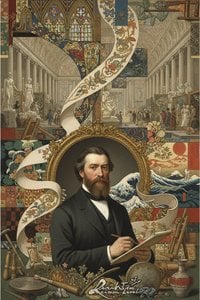
Jean Benner (1836 – 1906): A Capri Legacy
Jean Benner, born in Mulhouse, Alsace, in 1836, was a twin brother to Emmanuel Benner—a lineage inextricably linked to the burgeoning artistic landscape of late nineteenth-century France. Their father, Jean Benner-Fries, established them as designers at prominent mills and factories, providing a foundation for their subsequent pursuits in art. Recognizing his innate talent, Jean Benner diligently studied under luminaries like Léon Bonnat, Eck, and Jean-Jacques Henner, immersing himself in the traditions of Academic painting and gaining invaluable experience from observing fellow artists such as Frédéric Leighton and Walter McLaren. His debut at the Paris Salon in 1868 marked a pivotal moment, showcasing his burgeoning skill and establishing him within the artistic circles of the era.
- Early Life & Family Connections: Jean Benner’s upbringing was shaped by his father's textile business and the influence of his twin brother, Emmanuel, who also pursued artistic endeavors. Notably, he was the uncle of Emmanuel Michel Benner, furthering the family’s commitment to creative expression.
Academic Training & Artistic Influences: Henner’s mentorship instilled in Jean Benner a deep understanding of classical techniques and compositional principles—a cornerstone of Academic painting's emphasis on idealized beauty and meticulous detail. He absorbed the lessons of masters like Leighton and McLaren, mastering the conventions of monumental canvases and striving for harmonious balance. This formative period cemented his dedication to upholding artistic standards rooted in antiquity.
Jean Benner’s artistic output spanned diverse genres, including captivating still lifes brimming with vibrant color palettes reminiscent of Capri’s exotic flora, evocative portraits capturing the nuances of human emotion, and genre scenes depicting everyday life—often infused with a melancholic contemplation of existence. His fascination with Capri extended beyond mere observation; he became an active participant in its artistic community, alongside celebrated painters like Leighton, McLaren, Sargent, Sain, and Anderson. This environment fostered experimentation and encouraged him to explore innovative approaches while remaining firmly rooted in established conventions.
- Notable Paintings: Among his most acclaimed works are “Le Repos” (1868), a masterful depiction of tranquility; “Trappist in Prayer” (1875), reflecting spiritual contemplation; and “Petite Falle de Capri,” capturing the ethereal beauty of the island’s landscape.
He skillfully employed light and color to convey mood and atmosphere with precision, demonstrating an exceptional command of technique—a hallmark of Academic painting's pursuit of realism tempered by idealized form. Jean Benner’s meticulous brushwork and attention to textural detail exemplify the enduring legacy of his artistic vision. His canvases bear witness to a profound engagement with both natural beauty and human psychology—themes that continue to resonate within the annals of French art history. He passed away in Paris in 1906, leaving behind a body of work that embodies both artistic excellence and the indelible charm of Capri’s picturesque landscape.
- Legacy: Jean Benner's paintings are housed in museums across France, including the Louvre and Musée d'Orsay, ensuring his contribution to French art remains accessible for generations to come.
His artistic endeavors stand as a poignant reminder of the interconnectedness between family heritage and creative vocation—a story told through canvases imbued with the spirit of Capri and the unwavering pursuit of artistic mastery.