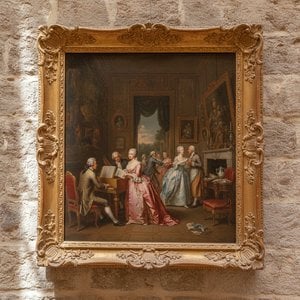
Jan Ekels the Younger: A Master of Dutch Genre Painting
Jan Hermannus Ekels (1759 Amsterdam – 1793) stands as a pivotal figure in late Baroque and early Neoclassical Dutch art, recognized primarily for his exquisitely rendered genre scenes—domestic interiors populated with believable characters engaged in everyday activities—and his unwavering dedication to emulating the stylistic brilliance of celebrated Old Masters like Jacob Molenaer, Gerard Ter Borch, and Gabriel Metsu. Born into a family steeped in artistic tradition – his father, Jan Ekels the Elder, was also a painter residing at Herengracht – Ekels’s formative years were marked by rigorous training under his father's tutelage, fostering an early appreciation for meticulous observation and skillful draughtsmanship.
His formal education extended beyond familial instruction; from 1776 to 1778, he pursued studies in Paris, immersing himself in the burgeoning currents of French Neoclassicism championed by Jean Siméon Chardin. This Parisian encounter proved transformative, exposing him to compositional principles rooted in classical ideals and cultivating a stylistic sensibility that would permeate his subsequent oeuvre. Notably, Ekels secured the first prize at the Drawing Academy in 1781—a prestigious honor accompanied by a medal and a seminal treatise on painting and drawing penned by Gerard de lairesse—further cementing his reputation as a rising talent within the artistic community.
A spirited traveler and intellectual, Ekels embarked upon an expedition along the Rhine in 1783 alongside two companions, venturing into Düsseldorf where he gained admittance to the Felix Meritis – a society dedicated to fostering artistic excellence. Throughout his life, Ekels remained unmarried and resided at Nieuwe Doelenstraat, establishing himself within a comfortable hotel after his mother’s passing; he was solely heir to her estate. Tragically, Ekels succumbed to illness at the young age of 34—likely due to a stroke—and was interred near Nieuwezijds Kapel, marking the poignant conclusion of a remarkably productive artistic career.
Ekels's contribution to Dutch art transcends mere stylistic imitation; he embodies the humanist ideals of the Enlightenment, reflecting a profound engagement with human experience and portraying individuals within relatable contexts. His paintings continue to captivate audiences today, serving as enduring reminders of the artistic brilliance achieved during a formative period in European cultural history. He remains an important artist for understanding the transition from Baroque to Neoclassicism in Dutch painting.
- Major Works: Ekels’s artistic legacy rests upon a collection of genre paintings that capture the nuances of Dutch domestic life with remarkable realism and sensitivity. Among his most notable achievements are “The Sense of Smell” (Conversation Piece), a masterful depiction of a family gathering imbued with atmospheric detail; “A Writer Trimming His Pen,” showcasing an intimate portrait of scholarly pursuits; and “Egbert van Drielst,” a collaborative effort reflecting the artistic spirit of the era.
- Influences: Ekels’s stylistic approach owes considerable debt to the Old Masters, particularly Molenaer's meticulous realism and Ter Borch’s dramatic chiaroscuro—techniques he skillfully adopted to convey emotion and depth within his canvases. Metsu’s ethereal luminosity served as an inspiration for capturing subtle nuances of light and color, contributing to Ekels’s distinctive visual aesthetic.
- Technique: Ekels excelled in draughtsmanship, demonstrating exceptional precision and anatomical accuracy—traits evident throughout his paintings. He employed a refined palette characterized by muted tones and subtle gradations, prioritizing tonal harmony and atmospheric perspective to create immersive environments that resonated with psychological realism.
His unwavering dedication to mastering the techniques of his predecessors ensured that Ekels’s work would resonate across generations. The meticulous detail in his depictions—from the folds of fabric to the expressions on faces—demonstrated a profound understanding of observation and representation, cementing his place as one of the most accomplished genre painters of his time. His canvases are not merely representations of scenes; they are windows into the human condition, inviting viewers to contemplate themes of family, intellect, and everyday life with quiet contemplation.