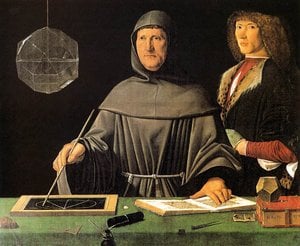
Jacopo de' Barbari: Venetian Master of Trompe l’oeil & Woodcuts
Jacopo de’ Barbari remains an enigmatic figure in Renaissance art history, shrouded in mystery regarding his birthdate and early life. Estimates place him between 1450 and 1470, though definitive proof is elusive. Contemporary accounts describe him as “old and weak” by 1511, suggesting a later date of origin—a fascinating paradox considering his remarkable artistic output during his lifetime. While Venetian origins are widely accepted based on biographical details like Albrecht Dürer’s reference (“van venedig geporn”), scholarly debate persists concerning his Germanic connections, ultimately pointing to an Italian heritage substantiated by surviving documents addressed to Germans. His formative years remain largely undocumented, though Alvise Vivarini is considered a possible mentor—a connection that underscores the artistic currents circulating within Venice at the time. Around 1500, he embarked on a transformative journey to Germany, where he served under Emperor Maximilian I in Nuremberg for a year and subsequently collaborated with Frederick III of Saxony in various locations between 1503 and 1505. This period cemented his reputation as “Jacop Walch,” reflecting the prevalent perception of Italians as foreigners within Germanic artistic circles. He continued his artistic endeavors at the court of Joachim I of Brandenburg from 1506 to 1508, demonstrating a consistent commitment to expanding his creative horizons. Barbari’s artistic breakthrough arrived in Nuremberg, where he produced his celebrated “Still Life with Fruits and Insects,” arguably the first instance of trompe l'oeil since antiquity—a technique that deliberately deceives the eye by creating illusions of depth and perspective. This groundbreaking approach was profoundly influenced by Andrea Mantegna and Albrecht Dürer, artists whose mastery of linear perspective and illusionistic rendering served as models for Barbari’s own stylistic innovations. The meticulous detail with which he depicted textures and surfaces—the glistening dewdrop on a peach, the velvety sheen of an insect wing—challenged conventional artistic conventions and established him as a pioneer in visual realism. His masterful use of chiaroscuro – dramatic contrasts between light and shadow – further heightened the illusionistic effect, transporting viewers into a world where appearances belie reality. His engravings, numbering twenty-nine, were equally influential, capturing the spirit of the Renaissance with meticulous detail and conveying a sense of realism that surpassed previous artistic achievements. Notably, his monumental woodcuts—particularly “The Triumph of Death”—became iconic representations of mortality and humanist thought, cementing Barbari’s place among the foremost printmakers of his era. The composition itself – a sprawling panorama populated by figures representing various stages of life – was deliberately unsettling, prompting contemplation on the inevitability of death while simultaneously celebrating human achievement. These prints were disseminated throughout Europe, disseminating humanist ideas and influencing artistic styles across generations. By 1510, Barbari was actively engaged in artistic commissions for Philip II of Burgundy and Margaret Tudor, demonstrating his versatility across mediums and signaling a shift towards collaborative projects within the burgeoning Netherlandish Renaissance. He continued to refine his technique, experimenting with new pigments and printing methods—a testament to his intellectual curiosity and unwavering dedication to mastering the art of his time. His final years were marked by illness and culminated in a poignant testament—a gesture reflecting both vulnerability and an enduring passion for artistic expression. The Archduchess Margaret’s generous pension underscored the recognition of Barbari's artistic legacy, securing him a place among the luminaries of his era. He died before 1516, leaving behind a body of work that continues to inspire admiration for its technical brilliance and conceptual depth—a testament to Jacopo de’ Barbari’s enduring contribution to Renaissance art and visual culture.Questions et réponses
Comment l'art de Jacopo De Barbari a-t-il évolué au fil du temps ?
Retrouvez l'itinéraire chronologique de l'œuvre de Jacopo De Barbari sur la page Parcours de carrière de l'artiste, où les œuvres se succèdent par périodes de création, chapitre par chapitre.
Où puis-je voir la palette de couleurs des œuvres de Jacopo De Barbari ?
Retrouvez le profil chromatique des œuvres de Jacopo De Barbari sur la page ADN de la palette de l'artiste.
Comment trouver des œuvres de Jacopo De Barbari par thème ?
La page Par mots-clés de Jacopo De Barbari regroupe les œuvres de l'artiste par mots-clés.