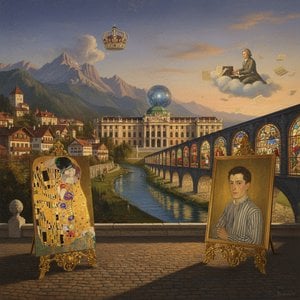
Top 3 works: Hubert Schmalix - I’m having a Bad Time
Museums on APS: Imago Mundi
En savoir plus…
Nationality: Autriche
Art period: Contemporain
Copyright status: Under copyright
Works on APS: 1
Hubert Schmalix: A Pioneer of Young Wilde Painting
Hubert Schmalix (1952 – 2025) emerged as a pivotal figure in Austrian art during the vibrant era of the junge wilde movement, cementing his legacy as one of its most influential voices. Born in Graz, Austria, Schmalix’s artistic journey began amidst the burgeoning countercultural fervor of the late 1970s, reacting against the prevailing trends of minimalist and conceptual art.
The junge wilde collective championed expressive painting characterized by bold colors and rapid brushstrokes—a stylistic approach profoundly shaped by Karl Horst Hödicke, a professor at Berlin’s Academy of Art. Schmalix's distinctive style fused realism with impressionistic techniques, capturing the essence of landscapes and figures with remarkable sensitivity. He sought to revitalize painting with a renewed focus on color and gesture, rejecting the intellectual detachment of dominant artistic philosophies.
Early Influences: Schmalix’s formative years were deeply impacted by Austrian Expressionism, particularly the works of Ernst Fuchs and Viktor Mischiek. These artists instilled in him a profound belief in painting as an instrument for conveying emotion and experience—a conviction that would become the cornerstone of his subsequent artistic endeavors. Their emphasis on subjective feeling and psychological exploration resonated powerfully with Schmalix’s own creative impulses.
The junge Wilde Movement: In 1978, Schmalix joined the junge wilde movement alongside Siegfried Anzinger, Erwin Bohatsch, Herbert Brandl, Gunter Damisch, Hubert Scheibl, and others. This collective represented a significant reaction against the prevailing artistic landscape of the time—a desire to reconnect with tangible visual experience and to express oneself freely through color and gesture. They championed a return to painterly materiality and rejected the sterile logic of conceptual art.
Notable Works: Schmalix’s oeuvre is marked by numerous landscapes imbued with luminous hues—particularly depictions of Austrian alpine vistas—that capture the grandeur and beauty of the natural world. His figurative paintings delve into themes of identity and psychological introspection, exploring inner states through evocative imagery and masterful brushwork. Among his most celebrated canvases is “La salle de billard au Ménil-Hubert,” painted by Edgar Degas in 1892, which embodies Impressionism with a warmth and precision that captures the spirit of Parisian daily life. Reproductions are available at WahooArt.com.
Schmalix’s artistic trajectory extended beyond Austria’s borders, culminating in a successful relocation to Los Angeles in 1987 where he established himself as a respected artist and educator. He taught at UCLA for nearly two decades, fostering the creativity of aspiring painters and sculptors—passing on his passion for painting and encouraging experimentation with new techniques.
International Recognition: Schmalix’s work gained international acclaim through participation in prestigious exhibitions such as Venice Biennale (1984), Fondation Cartier (1986), “An International Survey of Recent Painting and Sculpture” (Museum of Modern Art, New York), Sydney Biennale (1984), and numerous solo shows across Europe and North America. His paintings are housed in prominent museum collections including Neue Galerie Graz - Universalmuseum Joanneum, Österreichische Galerie Belvedere, Museum Moderner Kunst Stiftung Ludwig, Sammlung Essl, Albertina Modern, and Schlossmuseum Linz—a testament to the enduring power of his artistic vision. He remains a significant figure in contemporary Austrian art history.
Par la rédaction de WahooArt.com
Quiz d'art
Chaque question ne comporte qu'une seule bonne réponse.
Question 1:
Quel mouvement artistique est Hubert Schmalix principalement associé ?
Question 2:
Où Hubert Schmalix est-il né ?
Question 3:
Quelle académie Hubert Schmalix a-t-il fréquentée ?
Question 4:
Quel biennale a présenté le travail de Schmalix ?
Question 5:
Qu'est-ce que Schmalix est connu pour dans ses peintures ?
Embark on a sophisticated journey through the splendor of Austrian art. From Gustav Klimt’s golden masterpieces to the elegance of the Viennese Secession, discover the history and symbolism behind Europe's most iconic works for the discerning collector.
Embark on a sophisticated journey through Austrian art history. Explore the golden brilliance of Gustav Klimt and the elegance of the Vienna Secession through an expert lens, celebrating the enduring soul of Central European masterpieces.
Explore the vibrant revolution of Fauvism. Discover how masters like Matisse liberated color to redefine modern art. Dive into an expert-led journey through the 'Wild Beasts' movement and learn how to bring this bold, expressive energy into your personal collection.
Bonjour ! Je peux vous aider à choisir une œuvre d'art, à suivre une commande ou à répondre à vos questions sur la garantie. Comment puis-je vous aider ?