A Portraitist of Amsterdam’s Golden Age
Hillebrand Dirk Loeff (1774-1845) embodies the artistic spirit of Amsterdam during its celebrated “Golden Age,” a period defined by intellectual curiosity, artistic innovation, and societal grandeur. Born into a family with deep roots in artistic heritage, Loeff's formative years were marked by immersion in the stylistic currents of his time, primarily under the guidance of esteemed masters such as Johann Herman Ehrenberg and Johann Jacob Ludovicus Duyvelshoff. These mentors instilled within him not merely technical prowess but also an unwavering devotion to Neoclassical ideals – a movement that championed reason, order, and idealized beauty—a reflection of Europe’s intellectual landscape during Napoleon's reign.Early Training & Academic Recognition
Loeff’s fervent passion for artistic pursuits swiftly propelled him into membership of the Amsterdamse Tekenaar Academie (Amsterdam Drawing Academy), an institution renowned for nurturing talent and upholding excellence. This prestigious academy fostered a rigorous curriculum focused on anatomical accuracy, perspective, and classical composition techniques. Furthermore, he was honored with fellowship in organizations like Felix Meritis – a society dedicated to advancing arts and sciences—and Koninklijke Akademie van Beeldende Kunsten (Royal Academy of Fine Arts), securing his position as a prominent figure within Amsterdam’s artistic elite. These affiliations underscored Loeff's commitment to intellectual discourse and the dissemination of artistic knowledge.Genre Paintings & Portraiture: A Dual Artistic Vision
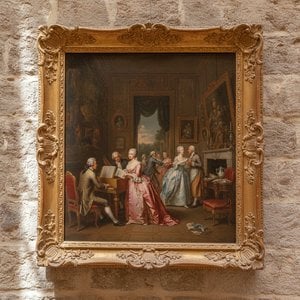
Loeff’s artistic output predominantly encompassed two distinct genres: portrait painting and genre scenes. His portraits meticulously captured the dignity and refinement of aristocratic families, rendered with subtle shading and painstaking detail—characteristics quintessential to Neoclassical artistry. Each canvas conveyed an aura of composure and elegance, mirroring the aesthetic sensibilities of the era. Simultaneously, Loeff produced evocative depictions of daily life in Amsterdam – bustling marketplaces brimming with activity, convivial gatherings fostering social connection, and intimate domestic interiors revealing glimpses into private existence. These genre paintings served as invaluable windows into the social customs and artistic tastes of his time, demonstrating Loeff’s versatility as an artist.Notable Works & Artistic Style
Among Loeff's most enduring achievements is “Portrait of Maria Adriana van der Sluys, Wife of Hermanus Martinus Eekhout,” completed between 1830 and 1838. This masterpiece exemplifies Loeff’s mastery of Neoclassical principles—a restrained palette dominated by muted tones—and a meticulous attention to anatomical accuracy and drapery folds. The portrait's serene expression and elegant attire convey an aura of aristocratic composure, reflecting the prevailing aesthetic standards of the period. Loeff’s style consistently prioritized clarity and balance, favoring compositions that conveyed emotion without resorting to excessive ornamentation. He skillfully employed chiaroscuro—the dramatic interplay of light and shadow—to sculpt form and imbue his subjects with depth and realism.Influence & Legacy
Loeff's influence extended beyond his immediate contemporaries; he served as a teacher to Ehrenberg and Duyvelshoff, transmitting his artistic knowledge and shaping the careers of future artists. His membership in esteemed art societies – including Koninklijke Nederlandse Akademie van Wetenschappen (Royal Dutch Academy of Sciences) and Société Royale des Beaux-Arts – underscored his dedication to intellectual engagement and artistic advancement. Loeff’s contribution to Dutch art history is undeniable; he represents the culmination of Neoclassical ideals and embodies the spirit of a city at its zenith—a testament to Amsterdam's enduring legacy as a center for artistic excellence during the Romantic era. His work continues to inspire artists today, reminding us of the power of observation, precision, and harmonious composition.Questions et réponses
Quelles œuvres de Hillebrand Dirk Loeff sont les plus consultées ?
Les statistiques relatives aux œuvres de Hillebrand Dirk Loeff sont disponibles sur la page Statistiques de l'artiste.
Puis-je étudier l'utilisation de la couleur par Hillebrand Dirk Loeff à travers l'ensemble de ses œuvres ?
L'usage de la couleur par Hillebrand Dirk Loeff à travers les œuvres répertoriées sur ce site peut être étudié sur la page ADN de la palette de l'artiste.
Comment la carrière de Hillebrand Dirk Loeff est-elle divisée en périodes ?
La Parcours de carrière de Hillebrand Dirk Loeff est une frise chronologique interactive qui se parcourt au défilement, présentant les œuvres de l'artiste par ordre chronologique et regroupées par périodes de sa carrière.