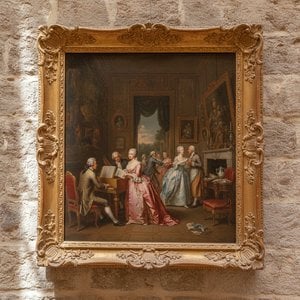
Henry Liverseege: A Painter Haunted by Infirmity and Inspired by Scott
Henry Liverseege (4 September 1802 – 13 January 1832) was an English genre painter of literary and folklore subjects, whose tragically short life yielded a remarkable body of work characterized by dramatic realism and meticulous detail. Despite debilitating physical ailments—asthma, spinal deformity resulting in scoliosis—and profound familial rejection—his father abandoned him—Liverseege persevered in pursuing his artistic ambitions, achieving recognition primarily through his evocative depictions of characters and narratives drawn from the Romantic era, notably Sir Walter Scott’s novels.Early Life and Physical Challenges
Born in Manchester to Edmund Liverseege, a joiner, Henry suffered from severe respiratory difficulties and spinal deformities from infancy. His frail constitution—reported to weigh as little as 70-75 lbs—presented significant obstacles to his physical development and profoundly impacted his life trajectory. Following his untimely death at the age of thirty, it was discovered that one lung had failed to develop entirely, highlighting the devastating consequences of his congenital condition. Raised primarily by his uncle John Green, a wealthy cotton mill owner, Liverseege received an education focused on classical studies but lacked formal artistic training. Nevertheless, he demonstrated early talent for drawing and theatrical performance, fueled by a passion for storytelling and visual representation—skills that would prove invaluable in shaping his artistic vision.Early Artistic Career: Portraits and Inn Signs
Liverseege commenced his artistic journey with commissions painting portraits at approximately five guineas each—a modest sum reflecting the prevailing economic conditions of the time and the critical assessment of his work as ‘indifferent.’ He eschewed grand ambition, prioritizing instead the portrayal of intimate scenes and conveying emotion through subtle nuances. Beyond portraiture, Liverseege gained renown for designing inn signs for Manchester hotels—a task that provided supplementary income but yielded similarly modest rewards. These early endeavors established him as a craftsman adept at rendering realistic figures and crafting visually appealing compositions—skills honed without the benefit of academic instruction. The limited financial resources available to aspiring artists during this period undoubtedly influenced Liverseege’s artistic choices, steering him away from monumental projects toward more accessible subjects and techniques.Turning Towards Literary Inspiration: Scott and Genre Painting
Around 1826 Liverseege transitioned from portraiture to genre painting, spurred by his fervent fascination with literature—particularly Sir Walter Scott’s novels. This pivotal shift marked a decisive departure from conventional artistic pursuits and cemented his commitment to translating literary narratives into compelling visual representations. His breakthrough came during exhibitions at the Royal Manchester Institution in 1827 where he presented three canvases—‘Banditti attacking travellers,’ ‘Banditti carousing,’ and ‘A robber on the outlook.’ While initial sales were modest, reflecting the challenges faced by emerging artists seeking commercial success, these works garnered considerable attention and established Liverseege’s reputation as a skilled genre painter capable of capturing the atmosphere of Victorian society with remarkable accuracy.Notable Achievements and Legacy
Liverseege continued to refine his technique and expand his repertoire throughout his brief career, producing several more paintings influenced by Romantic ideals—most notably “Edie Ochiltree, Sir Arthur Wardour and Isabella Wardour in the Storm An Illustration to Sir Walter Scott’s ‘The Antiquary.’” His meticulous attention to detail—evident in this depiction of a Victorian family scene—demonstrates Liverseege's mastery of composition and lighting. Furthermore, his portrayal of “The Betrothed” exemplifies neoclassical elegance and showcases his ability to convey profound emotion through visual imagery. Though Liverseege perished prematurely at just 30, leaving behind a comparatively small body of work, his paintings remain significant for their stylistic innovation—particularly the dramatic realism characteristic of Romantic genre painting—and for embodying the spirit of literary inspiration within Victorian art. His legacy endures as an artist who overcame physical limitations to produce evocative images that continue to resonate with audiences today—a testament to the enduring power of artistic perseverance and creative vision.Questions et réponses
Comment trouver des œuvres de Henry Liverseege par thème ?
Explorez les œuvres de Henry Liverseege par mot-clé sur la page Par mots-clés de l'artiste. Chaque mot-clé regroupe les œuvres associées.
Puis-je visiter un musée virtuel des œuvres de Henry Liverseege ?
Une visite virtuelle est possible : la page Musée en 3D de Henry Liverseege présente les œuvres de l'artiste dans une galerie en trois dimensions.
Dans quelle ville et quel pays Henry Liverseege est-il/elle né(e) ?
Henry Liverseege est né à Manchester, en Angleterre.