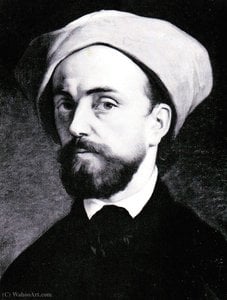
A Hungarian Voice in the Currents of Realism
Henrik Weber, born in Pest on May 24th, 1818, emerged as a pivotal figure in 19th-century Hungarian art—a painter who skillfully bridged the delicate sensibilities of the Biedermeier period with the burgeoning force of Realism. His life story is one of artistic dedication, navigating shifting aesthetic tides and contributing significantly to the development of a distinctly Hungarian national identity through his work. Initially steered toward a scientific path by his merchant father, Mihaly Wéber, young Henrik’s innate passion for drawing proved irresistible.
Sketchbooks filled with imaginative figures revealed a talent that could not be suppressed, leading his father to organize courses auprès de l'artiste local János Tóbiás Kärgling (1780-1845), where he quickly progressed. Weber’s formal artistic education began in 1835 at the Academy of Fine Arts Vienna. There, he came under the influence of Johann Ender and Leopold Kupelwieser, instructors who subtly guided him away from rigid academic conventions toward a more truthful representation of the world—a nascent embrace of Realism. To support his studies, Weber supplemented his income through teaching art lessons and working as a lithographer, demonstrating an early entrepreneurial spirit alongside his artistic pursuits.
Vienna and Development Artistique
At Vienna, he studied with Johann Ender and Leopold Kupelwieser, who profoundly impacted his rejection of the dominant academic style in favor of Realism. Recognizing Weber’s talent, Kärgling fostered his artistic development from a young age. His instructors championed an honest depiction of life, prioritizing accuracy and observation—a cornerstone of Weber's artistic philosophy.
Weber’s success quickly gained recognition, establishing him as a sought-after portrait painter in Vienna during the late 1830s. He diligently pursued his craft, honing his skills while simultaneously earning a living through teaching and lithography – activities that underscored his versatility and commitment to artistic excellence.
Munich and Peinture Historique
Around 1840, Weber relocated to Munich due to the waning demand for portraits in Vienna. This strategic move coincided with a renewed interest in historical painting—a genre he enthusiastically embraced. Facing financial difficulties, Weber turned his attention to commemorating Hungarian history, producing monumental canvases like “La Mort de Jean Hunyadi,” which achieved considerable acclaim.
This decisive shift cemented Weber’s position as a leading voice in Hungarian historical painting and solidified his reputation for capturing the grandeur of national narratives. He skillfully blended Biedermeier precision with Romantic fervor—a stylistic hallmark that distinguishes his oeuvre from many contemporaries.
Voyage en Italie et Retour en Hongrie
From 1845 to 1847, Weber traveled extensively in Italy, immersing himself in the landscapes and observing daily life. This journey yielded genre works depicting peasant life alongside evocative panoramas—reflecting an artist deeply attuned to the beauty of the natural world and the dignity of ordinary people.
Despite the inspiration derived from Italian art and scenery, Weber experienced a period of nostalgia for his homeland. He returned to Pest in 1847 resuming portraiture while continuing to explore landscape and historical painting—a testament to his adaptability and unwavering dedication to artistic pursuits.
A Legacy Forged Through Perseverance
Weber’s legacy resides not only in his impressive body of work but also in his steadfast commitment to artistic integrity. He mentored younger artists, notably Károly Lotz, shaping the trajectory of Hungarian painting for decades to come. His lithographs documenting pivotal moments in Hungarian history remain invaluable historical records—visual chronicles of a transformative era.
Weber’s paintings stand as enduring symbols of Hungarian Realism and Biedermeier aesthetics—a testament to his artistic vision and contribution to the nation's cultural heritage. He is remembered as a pioneer who championed truthfulness in representation and elevated Hungarian art to new heights.
Questions et réponses
Existe-t-il une liste complète des œuvres de Henrik Weber ?
Chaque œuvre de Henrik Weber sur ce site web peut être consultée depuis la page Toutes les œuvres de l'artiste.
Quelles œuvres de Henrik Weber sont les plus consultées ?
La page Statistiques de Henrik Weber présente des statistiques calculées à partir des œuvres de l'artiste répertoriées sur ce site web.
Puis-je parcourir les œuvres de Henrik Weber par technique ?
Les œuvres de Henrik Weber peuvent être consultées par technique sur la page Tous les médiums de l'artiste.