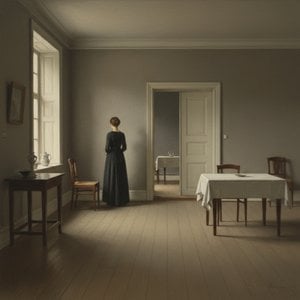
L'Architecte de Lumière et de Pierre : La Vie de Heinrich Hansen
Dans la grande tapisserie de l'art danois du XIXe siècle, peu de fils sont tissés avec autant de précision et d'élégance structurelle que ceux laissés par Heinrich Hansen. Maître capable d'insuffler la vie à la pierre froide et aux halls silencieux, Hansen n'était pas seulement un peintre de bâtiments, mais un poète de la perspective. Né en 1821 à Haderslev, son parcours, de fils d'un teinturier de Flensborg à celui de prestigieux Conseiller d'État et professeur à la Royal Danish Academy of Fine Arts, témoigne d'une vie dédiée à l'observation méticuleuse de la forme et de la lumière. Ses premières années en tant que peintre compagnon lui ont inculqué un respect fondamental pour l'artisanat — une compréhension tactile des matériaux qui lui permettra plus tard de rendre les textures du marbre, du bois et de la maçonnerlement avec un réalisme inégalé.
L'arrivée de Hansen à Copenhague en 1842 marqua le début d'une ère transformative. En s'inscrivant à l'Académie Royale des Beaux-Arts avec l'intention de devenir peintre décorateur, il démontra rapidement une aptitude pour les commandes prestigieuses de grande envergure. Sa collaboration précoce sur les décors opulents du Musée Thorvaldsen signala son émergence en tant que talent vital, capable d'assumer le poids de projets artistiques monumentaux. Cette période fut caractérisée par une quête incessante de maîtrise technique, comme en témoigne sa médaille d'argent obtenue en 1846 pour la peinture de modèle vivant, un exploit qui prouva sa capacité à capturer la vitalité organique de la vie, alors même qu'il se tournait vers les disciplines plus rigides de l'architecture.
Un Voyage à travers la Grandeur Européenne
La trajectoire de la carrière de Hansen fut profondément altérée par ses voyages, financés par le prestigieux Fonds Reiersenske. En 1847, un voyage en Allemagne lui permit d'affiner sa vision artistique et, surtout, de se consacrer à la discipline spécialisée de la peinture architecturale — devenant, par essence, le premier véritable praticien de ce genre au Danemark. En parcourant l'Europe occidentale, y compris les paysages baignés de soleil de l'Italie, Hansen absorba l'héritage profond des Maîtres Anciens. Le clair-obscur dramatique de Caravage et la profondeur atmosphérique de Rembrandt devinrent les instructeurs silencieux de son pinceau, lui apprenant à utiliser l'ombre pour définir le volume et la lumière pour suggérer les étendues infinies d'une nef de cathédrale.
Ses voyages n'étaient pas seulement observatoires mais productifs, aboutissant à des œuvres qui capturaient l'âme des monuments européens. Une réussite notable de cette époque fut sa représentation de l'Église de Notre-Dame du Sablon, une pièce si évocatrice de son cadre qu'elle fut acquise pour la Collection Royale. Cette période d'errance consolida sa capacité à traduire l'échelle monumentale de l'architecture historique en l'expérience intime d'une toile, mêlant la précision du dessinateur à l'âme du romantique.
Héritage de Perspective et de Prestige
À son retour au Danemark, l'influence de Hansen imprégna les institutions mêmes qui façonnèrent l'identité artistique de la nation. Après le décès de Gustav Friedrich Hetsch en 1864, Hansen accéda au poste de professeur de perspective à l'Académie, un rôle qu'il occupa avec distinction pendant de nombreuses années. Son impact pédagogique permit d'assurer que l'étude rigoureuse de l'espace, de la lumière et de l'ornementation se poursuive à travers les générations suivantes d'artistes danois. Au-delà des salles de classe, son travail sur des sites historiques importants — tel que la tâche monumentale d'embellir la chapelle funéraire du roi Christian IV à la cathédrale de Rosende aux côtés de Wilhelm Marstrand — a cimenté son statut de gardien du patrimoine architectural du Danemark.
La signification de Heinrich Hansen réside dans sa capacité unique à combler le fossé entre le décoratif et le profond. Son œuvre, allant de l'atmosphère d'une Chapelle Latérale à l'énergie bouillonnante du Marché aux Poissons, démontre une maîtrise polyvalente des différentes échelles de l'expérience humaine. À travers ses yeux, nous ne voyons pas seulement des bâtiments ; nous ressentons le poids de l'histoire, le calme des espaces sacrés et la majesté durable de l'environnement bâti. Il demeure une pierre angulaire de l'art académique danois, un artiste qui nous a enseigné que même la pierre la plus silencieuse recèle une histoire qui ne demande qu'à être illuminée.