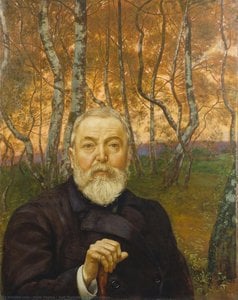
L'Âme de la Forêt-Noire : La Vie et la Vision de Hans Thoma
Hans Thoma s'impose comme une figure singulière de l'histoire de l'art allemand, célèbre pour ses paysages évocateurs et ses portraits qui capturent l'essence même de la Forêt-Noire, un lieu profondément ancré dans sa vision artistique. Né à Bernau bei Berlin en 1839, il entreprit un voyage artistique marqué par un dévouement indéfectible envers les traditions et le folklore de sa patrie. Sa vie fut un équilibre délicat entre une observation méticuleuse et un profond sentiment d'idéalisme romantique, donnant naissance à une œuvre qui semble à la fois ancrée dans la terre et élevée par une dimension onirique.
Les années de formation de Thoma furent façonnées par les rythmes simples de la vie rurale ; le métier d'horloger de son père lui inculqua une précision et une attention extraordinaire aux détails qui allaient plus tard imprégner chaque coup de pinceau. En 1859, il intégra l'Académie de Karlsruhe, où il fut guidé par des maîtres tels que Johann Wilhelm Schirmer et Ludwig Des Coulbres. Cette période établit sa maîtrise fondamentale des techniques de la peinture de paysage. Bien que ses voyages ultérieurs à Düsseldorf, Paris, en Italie, Munich et Francfort l'aient exposé au tourbillon de diverses tendances artistiques, ces rencontres internationales n'ont fait que renforcer son engagement à capturer l'essence de la vie rurale allemande et la beauté intemporelle de la nature.
Une Tapisserie d'Influences et de Techniques
Le style distinctif de Thoma défie toute catégorisation facile, et pourtant, il possède des affinités indéniables avec le mouvement préraphaélite. À l'instar des œuvres de Dante Gabriel Rossetti ou de John Everett Millais, Thoma privilégiait la capture des conditions atmosphériques et la transmission d'une émotion profonde à travers de subtiles variations tonales et des palettes de couleurs lumineuses. Sa fascination pour les détails infimes du monde naturel — la texture d'une feuille, la lumière filtrant à travers une canopée ou la présence paisible de vaches en pâturage — reflète un dévouement au réalisme qui est fréquemment tempéré par une vision imaginative, presque mystique.
La lignée des maîtres allemands a également joué un rôle pivot dans le façonnement de son esthétique. Les œuvres d'Albrecht Dürer et de Lucas Cranach l'Ancien furent des influences profondes, dictant ses choix compositionnels et sa capacité à rendre des contours précis et des ombrages soignés. Ce mélange de précision classique et de sentiment romantique lui permit de créer des scènes qui semblaient à la fois historiquement enracinées et émotionnellement immédiates. Que ce soit à travers un dessin en noir et blanc comme son Autoportrait de jeunesse ou un paysage vibrant et gorgé de couleurs tel que Arbre d'automne devant Wiesental, la prouesse technique de Thoma est restée centrée sur la quête de vérité au sein de la nature.
Héritage et Importance Artistique
Tout au long de sa carrière, Thoma atteignit un niveau de reconnaissance qui le plaça au cœur de la scène artistique allemande. Sa capacité à évoquer la sérénité par une verdure luxuriante et des cieux moutonneux — comme on peut le voir dans des œuvres telles que Paysage avec nuage — démontre une sensibilité presque impressionniste à la lumière et à l'air. Il ne se contentait pas de peindre des décors ; il peignait l'atmosphère d'une culture et d'un paysage, transformant la Forêt-Noire en un symbole de paix durable et de beauté pastorale.
L'importance historique de Hans Thoma réside dans sa capacité à jeter un pont entre les rigoureuses traditions académiques du XIXe siècle et l'émotionnalité naissante de l'art moderne. Ses accomplissements incluent :
- La maîtrise du paysage : La création d'un langage visuel définitif pour la campagne allemande, mêlant réalisme et romantisme.
- <La polyvalence technique : Une transition fluide entre des dessins précis et détaillés et des paysages picturaux atmosphériques.
- <La préservation culturelle : La documentation du folklore, des traditions et de la splendeur naturelle de la région de la Forêt-Noire durant une période de mutations industrielles rapides.
Aujourd'hui, l'œuvre de Thoma continue de résonner auprès des spectateurs en quête de réconfort dans l'idylle et l'éternité. Ses peintures demeurent des fenêtres ouvertes sur un monde où la nature et l'humanité coexistent dans une danse harmonieuse et magnifiquement détaillée.
Questions et réponses
Puis-je étudier l'utilisation de la couleur par Hans Thoma à travers l'ensemble de ses œuvres ?
Retrouvez le profil chromatique des œuvres de Hans Thoma sur la page ADN de la palette de l'artiste.
Où peut-on trouver les œuvres de Hans Thoma regroupées par mouvement artistique ?
Retrouvez les mouvements associés à Hans Thoma sur la page Tous les mouvements artistiques de l'artiste, qui regroupe ses œuvres par mouvement.
Dans quelle ville et quel pays Hans Thoma est-il/elle né(e) ?
Hans Thoma est né à Bernau bei Berlin, en Allemagne.