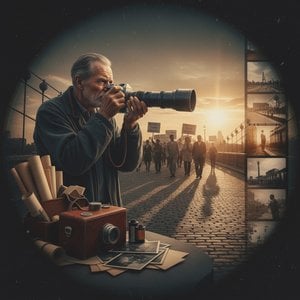
Gusmano Cesaretti: Capturing Urban Soul Through Photographic Witness
Gusmano Cesaretti (born July 24, 1944) stands as a singular figure in Italian photography—a self-taught artist who has dedicated his life to documenting the vibrant pulse of urban landscapes and human connection. Rooted in Lucca, Italy, Cesaretti’s artistic journey began organically, fueled by an innate curiosity and a profound appreciation for visual storytelling. He established Cityscape Foto Gallery in Pasadena, California, in 1977, marking the genesis of his career as both photographer and curator—a dual role that would define his subsequent endeavors.
Early Influences: Cesaretti’s formative years were profoundly shaped by exposure to humanist photography, particularly the work of Henri Cartier-Bresson and Eugène Atget. These pioneers instilled in Cesaretti a conviction that photography could serve as a conduit for understanding human experience and conveying its essence with uncompromising honesty—a belief that would permeate his artistic practice throughout his career. Cartier-Bresson’s meticulous attention to detail and decisive moments, combined with Atget's evocative depictions of Parisian life before the Second World War, established Cesaretti’s aesthetic bedrock.
The East Los Angeles Project: Cesaretti’s breakthrough arrived in 1970 with his groundbreaking photographic chronicle of East Los Angeles street culture—a project that cemented his reputation as one of the first to authentically portray the Chicano movement. He undertook a painstaking investigation into this marginalized community, capturing scenes of daily life, vibrant graffiti art, and impassioned musical performances. This ambitious undertaking wasn’t merely about recording images; it was about conveying the spirit of East LA—its struggles, its triumphs, and its unwavering determination to express itself artistically. Cesaretti's photographs became emblematic of a new approach to documentary photography, prioritizing empathy and capturing the raw energy of social reality.
Expanding Horizons: From 1975 onwards, Cesaretti embarked on extensive expeditions across continents—Cuba, Bolivia, Panama, Brazil, Mexico, China, Thailand, Lebanon, Israel, Africa—each offering unique perspectives on human society and the interplay between environment and culture. These journeys yielded a remarkable body of work characterized by meticulous observation and an unwavering commitment to capturing fleeting moments that encapsulate the essence of their respective locations. Cesaretti’s photographs documented diverse subjects—from bustling marketplaces in Marrakech to serene landscapes in Patagonia—demonstrating his versatility as an artist and his ability to translate complex ideas into visually compelling images.
Collaborations Beyond Photography: Recognizing the transformative power of visual storytelling, Cesaretti extended his artistic vision beyond the confines of photography, forging fruitful collaborations with influential filmmakers like Michael Mann, Tony Scott, and Marc Forster. He served as a producer and visual consultant on films such as *Blackhat*, *Unstoppable*, *Public Enemies*, *The Taking of Pelham 123*, *Quantum of Solace*, *Collateral*, *Heat*, *Miami Vice*, “Stay,” and *Manhunter*, contributing to the creation of distinctive cinematic atmospheres. Cesaretti’s understanding of visual composition and storytelling—skills honed through his photographic practice—proved invaluable in shaping the aesthetic qualities of these films, solidifying his position as a respected figure within Hollywood's creative landscape.
Recognition and Legacy: Cesaretti’s artistic achievements have garnered widespread acclaim from prestigious institutions—the Smithsonian Institution and the Los Angeles Museum of Contemporary Art—securing his place within the annals of twentieth-century photography. His work has been exhibited internationally, showcasing his dedication to exploring diverse cultural contexts and conveying profound human emotions through visual media. Furthermore, Cesaretti’s enduring influence continues to inspire photographers and filmmakers alike, ensuring that Gusmano Cesaretti's photographic gaze remains a powerful testament to the beauty and complexity of human experience—a legacy rooted in honesty, observation, and an unwavering belief in the transformative potential of art.