jeunesse et formation
govaert flinck, peintre néerlandais de premier plan, est né le 25 janvier 1615 à kleve, la capitale du duché de clèves. son père, un marchand de soie, l'a d'abord formé à son propre métier, mais la passion de govaert pour l'eau-forte et le dessin l'a conduit vers une nouvelle destinée sous l'égide de lambert jacobszoon, un peintre mennonite établi à leeuwarden.développement artistique et influences
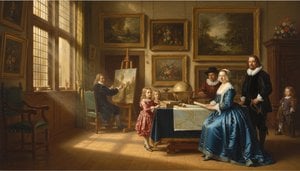
le style artistique de govaert flinck fut profondément marqué par l'âge d'or néerlandais, avec rembrandt van rijn comme l'un de ses mentors les plus marquants. les premières œuvres de flinck, à l'instar de son portrait de 1636 conservé dans la galerie de brunswick, témoignent d'un véritable effet rembrandtesque, caractérisé par une vigueur et une chaleur saisissantes.œuvres notables et commandes
* la bénédiction de jacob (1638), conservée au rijksmuseum d'amsterdam, marque la première œuvre à sujet narratif de flinck. * les quatre miliciens de 1642 et les douze mousquetaires avec leur président dans un fauteuil (1648), tous deux exposés à l'hôtel de ville d'amsterdam, démontrent sa maîtrise exceptionnelle des portraits de groupe complexes. * la paix de münstér au rijksmuseum, mettant en scène 19 personnages grandeur nature, constitue un exemple magistral du travail de flinck durant cette période.héritage et fin de vie
govaert flinck s'éteignit le 2 février 1660 à amsterdam. son héritage comprend de nombreux portraits et peintures historiques, tels que l'expulsion d'haggar, aujourd'hui conservée au musée de berlin. [https://WahooArt.com/@/govaert-flinck](https://WahooArt.com/@/govaert-flinck) propose une collection complète de ses œuvres.- admirez les peintures de govaert flinck, notamment un érudit assis à un bureau, au mauritshuis (la haye, néerlands), sur [https://WahooArt.com/@@/8ydt6z-rembrandt-van-rijn-a-scholar-seated-at-a-desk](https://WahooArt.com/@@/8ydt6z-rembrandt_van-rijn-a-scholar-seated-at-a-desk)
- explorez le mouvement artistique de l'âge d'or néerlandais et ses caractéristiques sur /en/art/show/art-d3cph3-en/
- découvrez davantage sur la vie et les œuvres de govaert flinck au museum boijmans van beuningen rotterdam, néerlands, présenté sur [https://WahooArt.com/@@/a@d3arrk-museum-boijmans-van-beuningen-rotterdam-netherlands](https://WahooArt.com/@@/a@d3arrk-museum-boijmans-van-beuningen-rotterdam-netherlands)
Questions et réponses
Où et en quelle année Govaert Flinck est-il né ?
Govaert Flinck est né à Krefeld en 1615.
Combien d'œuvres de Govaert Flinck sont disponibles à la consultation ?
Vous pouvez parcourir 4 œuvres d'art œuvres de Govaert Flinck sur la page Toutes les œuvres.
Comment la carrière de Govaert Flinck est-elle divisée en périodes ?
Un récit chronologique de l'œuvre de Govaert Flinck est disponible sur la page Chronologie de l'artiste, où les œuvres défilent par ordre de création, chapitre par chapitre.