A Sculptor Rooted in Compassion: Exploring the Legacy of Godefroid Devreese
Godefroid Devreese (August 1861 – August 31, 1941) stands as a quietly influential figure within Belgian sculpture of the early twentieth century. Born in Courtrai, Belgium, his artistic journey unfolded against the backdrop of significant social and political transformations—a period marked by burgeoning nationalism and anxieties surrounding industrialization—influences that undeniably shaped his oeuvre. While Devreese’s name might not resonate with mainstream art history as loudly as some contemporaries, his sculptures possess a profound emotional resonance and offer valuable insights into the humanist concerns prevalent during his time.
Early Life & Artistic Training:
Godefroid Devreese's formative years were steeped in the artistic traditions of Flanders, where he honed his skills under the tutelage of prominent sculptors. This grounding in classical aesthetics combined with a burgeoning fascination for Impressionistic techniques—particularly evident in artists like Claude Monet and Pierre Auguste Renoir—established the stylistic bedrock upon which his subsequent creations would rest. He embraced realism as a primary tool, prioritizing meticulous observation and anatomical accuracy to convey emotion and narrative depth. Unlike many sculptors of his era who sought grandeur or heroic narratives, Devreese consistently focused on portraying human vulnerability and empathy. His father, Constant Devreese, was himself a sculptor, providing him with an invaluable foundation for artistic development. He pursued his studies at Kortrijk Academy and subsequently enrolled at the Royal Academy of Fine Arts in Brussels, where he studied under Eugène Simonis and Charles Van der Stappen—artists who instilled in him a dedication to anatomical precision and expressive modeling.
Notable Works: ‘Food Parcel for an Imprisoned Soldier’
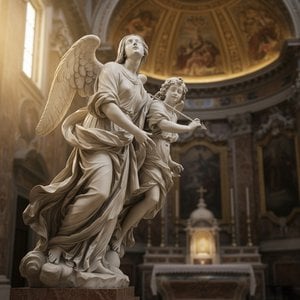
Perhaps Devreese's most enduring contribution to the artistic landscape is his sculpture “Food Parcel for an Imprisoned Soldier,” executed in 1936. This poignant depiction captures a moment of profound compassion during wartime—a woman tenderly offering a loaf of bread to a soldier wounded in battle. The simplicity of the composition belies its powerful message: a gesture of human kindness amidst suffering and hardship. Devreese skillfully utilizes expressive modeling to convey psychological depth, capturing subtle nuances of emotion through careful attention to detail. Unlike many sculptors preoccupied with monumental commissions or idealized representations, he championed unflinching portrayals of human experience—a characteristic that distinguishes him from his peers and underscores his humanist ethos. The sculpture’s enduring appeal lies in its ability to evoke contemplation on themes of solidarity and empathy—qualities that remain central to Devreese's artistic vision.
Technique & Style:
Devreese’s artistic style can be characterized as firmly rooted in realism, yet tempered by Impressionistic sensibilities. He meticulously studied anatomy and utilized techniques borrowed from Auguste Rodin—particularly the use of expressive modeling to convey psychological depth—to imbue his sculptures with palpable emotion. His approach differed markedly from many sculptors of his time who favored idealized forms or grand narratives; instead, Devreese prioritized conveying human vulnerability and empathy through nuanced observation and skillful craftsmanship. He embraced a palette of earthy tones—primarily browns and ochres—reflecting the influence of Impressionism while maintaining a commitment to anatomical accuracy. This stylistic blend resulted in sculptures that are both aesthetically compelling and emotionally resonant—works that continue to captivate viewers with their understated beauty and profound psychological insight.
Influence of Auguste Rodin and Impressionism:
Devreese’s artistic sensibilities were profoundly shaped by the legacy of Auguste Rodin, whose sculptural explorations of emotion and expressive modeling served as a guiding inspiration. Like Rodin, Devreese championed the depiction of human experience with uncompromising honesty—rejecting idealized representations in favor of nuanced portrayals that captured the complexities of human psychology. Simultaneously, he absorbed Impressionistic techniques from artists such as Claude Monet and Pierre Auguste Renoir, incorporating elements of atmospheric perspective and dappled light to imbue his sculptures with a sense of immediacy and vibrancy. This dual influence resulted in a distinctive artistic style—one characterized by both anatomical precision and perceptual sensitivity—that distinguishes Devreese from many sculptors of his era.
Legacy & Historical Significance:
Godefroid Devreese’s enduring legacy resides not in grand monuments or celebrated triumphs but rather in the quiet contemplation evoked by works like “Food Parcel for an Imprisoned Soldier,” which continue to inspire reflection on compassion and social responsibility. He achieved considerable renown as a sculptor and medalist, becoming a permanent participant in numerous exhibitions around the world—a testament to his artistic talent and unwavering dedication. Devreese was recognized as one of Belgium’s most prominent sculptors, receiving prestigious awards including the Grand Prix de Belgique (1882; 1886) and the Godecharle Prize for his sculpture ‘David with the Head of Goliath’ (1885). He was admitted to the Société Nationale des Beaux-Arts de France in 1895, showcasing his work alongside fellow artists—a pivotal moment in establishing Devreese's reputation as a leading figure within Belgian artistic circles. His contributions extended beyond monumental sculptures; he designed over 400 medals for the Royal Belgian Mint, demonstrating his mastery of numismatic arts and furthering his renown as an innovator. Notably, he was honored with titles such as Honorary Member of the Academy of Brussels, Commander of the Order of Leopold, Officer of the Order of the Crown and Legion of Honour—symbols of recognition for his artistic achievements and unwavering commitment to Belgian culture.