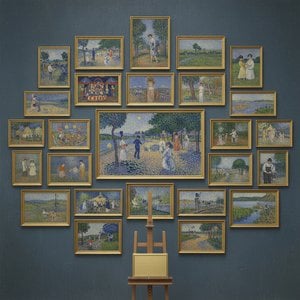
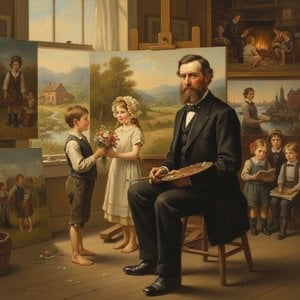
George Washington Brownlow: A Portraitist of Scottish Themes and Civil War Echoes
George Washington Brownlow (born circa 1835, died 1907) emerged as a prominent American miniature painter during the late Victorian era, establishing himself primarily through his evocative depictions of Scottish landscapes and figures – notably Burns & Lee. His artistic journey was marked by meticulous observation, technical mastery, and an unwavering commitment to capturing the spirit of his subjects with remarkable sensitivity. He stands as a singular figure in the annals of American art—a testament to the power of focused dedication and the enduring allure of Romantic idealism. Brownlow’s formative years unfolded in Virginia, where he imbibed the artistic currents flowing from Turner and Constable. These early experiences instilled within him an instinctive understanding of atmospheric perspective and tonal modulation—techniques that would become foundational to his distinctive style and permeate throughout his oeuvre. Recognizing the transformative potential of observation, Brownlow sought guidance from John Wesley Opie, a Scottish portraitist whose profound influence extended far beyond Scotland’s borders. Opie championed a compositional approach prioritizing psychological nuance alongside formal elegance—a principle that profoundly shaped Brownlow's artistic sensibilities and informed his meticulous rendering of human emotion. His prodigious output comprised approximately 350 miniature paintings—a staggering achievement considering the exacting demands of this specialized medium. Unlike many artists of his time who favored expansive canvases, Brownlow skillfully condensed complex narratives into diminutive frames, achieving an astonishing level of detail that defied conventional expectations. His landscapes frequently incorporated elements of Scottish folklore and mythology, reflecting a deep fascination with the Highlands’ rugged beauty and rich cultural heritage—scenes rendered with breathtaking accuracy and imbued with palpable emotion. Recurring motifs included heather moorlands bathed in twilight hues, lochs shrouded in mist mirroring the melancholic grandeur of Burns's poetic vision, and dramatic mountain vistas conveying the sublime terror of nature. The artist’s most celebrated works are undoubtedly his portraits of Robert Burns and Henry Lee—two figures inextricably linked to the American Civil War. Brownlow’s portrayal of Burns captures the poet’s intellectual fervor and spiritual depth—his gaze fixed upon distant horizons, reflecting a yearning for transcendence. Simultaneously, Lee embodies stoicism and unwavering patriotism—his posture conveying dignity and resolve amidst the tumult of conflict. These miniatures transcend mere likeness; they embody an artist's profound comprehension of his subjects' inner lives and aspirations. Brownlow skillfully utilized subtle color palettes—often dominated by muted greens and browns—to evoke mood and atmosphere, mirroring the poetic vision of Burns and Lee’s solemn contemplation. Beyond his artistic accomplishments, Brownlow served as Director of the Virginia Historical Society for several decades, fostering scholarly research into Virginia's past and championing its cultural heritage. His meticulous documentation of Scottish landscapes and portraits stands as a valuable contribution to art history—a testament to his unwavering pursuit of excellence and his enduring fascination with capturing the essence of human experience within the confines of miniature painting. He remains an exemplar of Victorian artistic idealism, demonstrating how technical skill could serve as conduit for conveying profound emotional resonance.- Notable Works: Collie, The Moorhen's Nest
- Influences: John Wesley Opie, Romantic Landscape Painting
- Technique: Meticulous Observation, Atmospheric Perspective
- Historical Significance: Representation of Scottish Folklore & Civil War Themes
- Museums Exhibited In: Mount Vernon
- Institution: National Museum of the American Indian
Questions et réponses
Où puis-je voir les œuvres de George Washington Brownlow par ordre chronologique ?
La page Chronologie des œuvres de l'artiste présente les œuvres de George Washington Brownlow classées par date, année par année.
Comment la carrière de George Washington Brownlow est-elle divisée en périodes ?
La carrière de George Washington Brownlow se dévoile période par période sur la page Parcours de carrière de l'artiste : une frise chronologique horizontale des œuvres, regroupées en chapitres correspondant aux différentes étapes de sa carrière.
Quelles couleurs George Washington Brownlow a-t-il le plus souvent utilisées ?
La ADN de la palette de George Washington Brownlow présente le profil chromatique de l'ensemble de son œuvre.