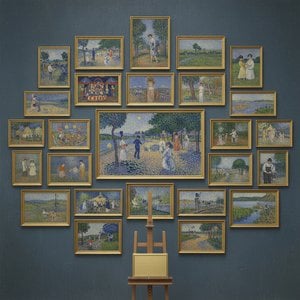
Le Rembrandt d'Angus : La vision habitée de George Paul Chalmers
Dans les paysages brumeux et imprégnés d'embruns de l'Écosse du XIXe siècle, peu d'artistes ont capturé la beauté éphémère des Highlands avec une intimité aussi profonde que George Paul Chalmers. Affectueusement surnommé par ses contemporains le « Rembrandt d'Angus », Chalmers possédait un talent rare pour insuffler la vie aux terrains accidentés de Montrose et de ses environs. Né en 1833 d'un capitaine de navire côtier, ses premières années furent imprégnées de l'atmosphère maritime de la côte écossaise, une éducation qui a sans aucun doute nourri sa fascination de toujours pour les scènes marines et le jeu dramatique de la lumière sur la mer. Son parcours, de jeune garçon esquissant dans l'ombre de Montrose à membre célébré de la Royal Scottish Academy, témoigne d'un talent qui cherchait à trouver l'éternel au cœur des instants fugaces de la nature.
La trajectoire du développement artistique de Chalmers fut irrévocablement façonnée par son passage à la Trustees' Academy d'Édimbourg. Sous la tutelle rigoureuse et inspirante de Robert Scott Lauder, Chalmers a dépassé la simple représentation pour atteindre une maîtrise plus sophistiquée du réalisme académique. C'est là qu'il a affiné un style distinctif, caractérisé par une touche de peinture libre et expressive — une technique qui privilégiait les effets atmosphériques de la lumière et de la couleur au détriment d'un dessin rigide. Cette approche lui permettait de manipuler le clair-obscur, utilisant des ombres profondes et des éclats soudains de luminosité pour imprégner ses toiles d'un sentiment d'émotion palpable. Qu'il dépeigne le charme rural serein de « The Ford » ou les panoramas d'une beauté envoûtante sur l'île de Skye, son œuvre a toujours conservé un noyau de profondeur psychologique qui résonnait bien au-delà des frontières de l'Écosse.
Un héritage de portraits et de paysages
Si ses paysages sont célébrés pour leur puissance évocatrice, les prouesses de Chalmers en tant que portraitiste demeurent la pierre angulaire de son importance historique. Il possédait un don remarquable pour capturer la dignité, la grâce et l'essence intérieure de ses sujets, allant des habitants locaux aux grandes figures du monde de l'art. Ses portraits n'étaient pas de simples ressemblances, mais de véritables études psychologiques ; dans des œuvres telles que « Mrs May Toriente », on perçoit une attention méticuleuse aux détails qui honore le rang social du sujet tout en révélant une tendre vulnérabilité humaine. Cette capacité à jeter un pont entre la précision académique formelle et la résonance émotionnelle a fait de lui un peintre très convoité de son époque.
Au-delà de l'atelier, le répertoire de Chalmers s'est étendu aux scènes de genre et aux récits historiques qui reflétaient l'esprit du temps de l'Écosse victorienne. Son lien avec les traditions littéraires de sa patrie est manifeste dans des œuvres comme « The Legend », une esquisse précoce inspirée par les contes évocateurs de Sir Walter Scott. Cette intersection entre l'art visuel et le récit national a aidé à consolider sa place au sein du mouvement plus large du romantisme écossais. Même lorsqu'il explorait des intérieurs plus intimistes ou des sujets maritimes, un fil conducteur de tension atmosphérique parcourait son œuvre, suggérant que chaque paysage et chaque visage recelait une histoire qui ne demandait qu'à être murmurée.
La vie de George Paul Chalmers fut tragiquement interrompue en 1878, à l'âge de quarante-quatre ans, à la suite d'une chute accidentelle. Pourtant, l'impact de sa carrière brève mais brillante continue de perdurer. Ses contributions à la Royal Scottish Academy et son rôle de médiateur entre le réalisme traditionnel et les approches plus expérimentales des futurs Scottish Colourists assurent sa place durable dans l'histoire de l'art. Aujourd'hui, nous contemplons son travail non pas seulement comme des artefacts historiques, mais comme des fenêtres ouvertes sur une Écosse disparue — un monde de brume, de lumière et d'esprit éternel que Chalmers a capturé avec une maîtrise inégalée.
Questions et réponses
Où trouver les œuvres de George Paul Chalmers classées par couleur ?
L'Index spectral de George Paul Chalmers est une page qui organise les œuvres de l'artiste par couleur.
Combien d'œuvres de George Paul Chalmers sont disponibles à la consultation ?
Vous pouvez parcourir 127 œuvres d'art œuvres de George Paul Chalmers sur la page Toutes les œuvres.
Dans quelle ville et quel pays George Paul Chalmers est-il/elle né(e) ?
George Paul Chalmers est né à Montrose, en Écosse.