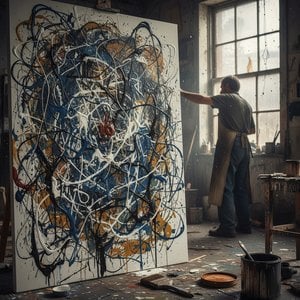
Gastone Novelli: Echoes of Resistance and Texture
Gastone Novelli (1925-1968) stands as a pivotal figure in the burgeoning Italian Informalist movement, an artistic reaction to the austerity of postwar Europe that prioritized materiality and visceral expression over traditional representational concerns. Born in Vienna, Austria, his early life was marked by exposure to intellectual ferment—his father was a professor of philosophy—before he relocated to Rome with his family in 1943, coinciding with the outbreak of World War II. This period profoundly shaped Novelli’s worldview and fueled his involvement in the Italian Resistance movement, an experience that instilled within him a deep commitment to political engagement and informed much of his artistic output. Imprisonment during the war served as a catalyst for introspection and solidified his resolve to confront societal injustices through art.
Following liberation, Novelli embarked on his artistic journey, initially exploring figurative painting but swiftly gravitating towards abstraction. Influenced by Surrealist techniques—particularly automatism—and energized by the expressive dynamism of American Expressionism, he developed a distinctive visual language characterized by bold brushstrokes and deliberately rough textures. These elements weren’t merely stylistic choices; they represented Novelli's desire to capture the emotional intensity of lived experience and to convey a sense of urgency about the political landscape of his time. He meticulously built up surfaces with pigment and found materials—fragments of wood, burlap, and metal—creating canvases that pulsed with palpable energy. This approach mirrored the broader ethos of Informalist artists who sought to bypass rational thought and tap into primal instincts.
Novelli’s artistic explorations extended beyond purely formal considerations. His works frequently tackled themes of social responsibility and critique, reflecting anxieties surrounding fascism and its aftermath. Pieces like “La Liberazione” powerfully depict the struggle for freedom, utilizing fragmented imagery and textured surfaces to convey both physical hardship and spiritual resilience—a visual testament to the courage required to resist oppression. Similarly, "La Montagna degli Adepti" presents a monumental landscape imbued with symbolic significance—the mountain representing aspiration and overcoming obstacles—further demonstrating Novelli’s preoccupation with confronting existential challenges. The deliberate use of textural elements underscored his belief that art could communicate truths inaccessible to verbal discourse.
His contribution to Italian Informalism cemented his place within the broader context of postwar European art alongside luminaries like Lucio Fontana and Piero Manzoni, all united in a rejection of academic conventions. Artists like Fontana famously punctured canvases with nails, disrupting established visual hierarchies and questioning notions of containment—a radical gesture that mirrored Novelli’s own preoccupation with challenging accepted paradigms. Novelli wasn't interested in replicating reality; he aimed to generate feeling, to provoke contemplation about the human condition. He sought to engage viewers on an emotional level, bypassing intellectual analysis and accessing deeper psychological resonances.
Gastone Novelli died prematurely in Rome in 1968, leaving behind a legacy of approximately fifty paintings that continue to resonate with collectors and critics alike. His work remains an enduring testament to the power of art as a vehicle for political expression and a celebration of textural richness—a reminder that beauty can emerge from confronting difficult truths. He is remembered not only for his innovative technique but also for his unwavering dedication to artistic integrity and his profound engagement with the complexities of human experience.