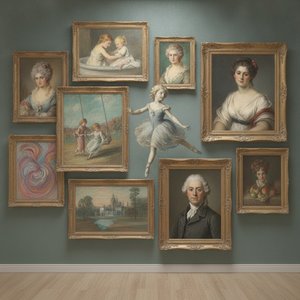
La Grâce Éthérée de Gaston Bouy
Dans le paysage vibrant et mouvant de la France de la fin du XIXe siècle, peu d'artistes ont su capturer l'intersection délicate entre l'intimité et l'élégance comme Henri-Gaston-Jules-Louis Bouy. Connu du monde de l'art simplement sous le nom de Gaston Bouy, il émergea de la banlieue parisienne, plus précisément de Bois-Colombes, pour devenir un maître du pastel. Sa vie, s'étendant de 1866 à 1943, coïncida avec une ère transformative de l'esthétique européenne, où les structures rigides du réalisme académique commençaient à céder la place aux rythmes fluides et organiques de l'Art Nouveau et aux expérimentations lumineuses de l'Impressionnisme.
Le voyage artistique de Bouy était ancré dans les traditions rigoureuses de l'excellence française. Sa formation formelle à la prestigieuse Académie Julian et à l'École des Beaux-Arts lui assura une base technique formidable. Durant ces années formatrices, il respira l'atmosphère d'un Paris en pleine révolution créative, absorbant les leçons subtiles de maîtres tels qu'Auguste Renoir et Camille Pissarro. De ces derniers, il hérita une profonde sensibilité aux qualités éphémères de la lumière et la capacité de traduire les nuances atmosphériques sur une surface, bien qu'il finît par orienter son talent vers une expression plus spécialisée et aux contours plus doux.
Une Maîtrise de la Lumière et du Pastel
Alors que nombre de ses contemporains recherchaient la permanence et le poids de l'huile sur toile, Bouy trouva sa véritable voix dans la poussière éphémère des pastels. Ce choix de medium était au cœur de son identité d'artiste. Contrairement à la nature lourde et lente au séchage de l'huile, le pastel lui offrait un sentiment d'immédiateté et une luminosité unique permettant des gradations tonales inégalées. Il possédait une capacité rare à superposer de délicats traits de pigment, mélangeant méticuleusement les couleurs pour créer des surfaces qui semblaient briller de l'intérieur. Cette technique conférait à ses portraits une qualité éthérée, presque onirique, rendant la peau de ses sujets translucide et leur présence d'une sérénité envoûtante.
Son sujet principal — la forme féminine — devint un véhicule pour explorer les idéaux de beauté prévalents durant la Belle Époque. Par son observation méticuleuse, Bouy ne se contentait pas de peindre des visages ; il capturait les nuances subtiles de l'émotion, la courbe douce d'un cou et la dignité tranquille d'un regard. Son œuvre incarne l'essence même de l'Art Nouveau, caractérisée par :
- Une Fluidité Organique : Une intégration sans couture du sujet et de l'atmosphère à travers des lignes fluides.
- Des Textures Lumineuses : L'utilisation du pastel pour obtenir un teint de peau doux et velouté ainsi qu'une lumière rayonnante.
- Une Beauté Idéalisée : Un accent mis sur la grâce, l'élégance et l'esprit féminin romancé.
Héritage et l'Art de l'Affiche
Au-delà des confins intimes du portrait, le talent de Bouy s'étendit au monde bourgeonnant de l'art commercial et de la lithographie, où son esthétique pouvait atteindre un public beaucoup plus large. L'une de ses réussites les plus durables demeure l'affiche de 1897 "Chocolat Delacre." Cette œuvre constitue un magnifique spécimen du design Art Nouveau, mêlant l'attrait du luxe à une figure féminine gracieuse pour créer une image qui fut à la fois un triomphe commercial et une pièce d'art majeur. Elle démontra sa capacité à marier des techniques sophistiquées des beaux-arts aux exigences graphiques audacieuses du médium de l'affiche.
L'importance historique de Gaston Bouy réside dans son rôle de pont entre la formation classique des Beaux-Arts et les mouvements modernes axés sur les sens au tournant du siècle. Il demeure une figure célébrée pour ceux qui rechercheent le côté poétique de l'art français — un peintre capable de transformer un simple pigment en un témoignage vivant et lumineux de l'élégance. Son travail continue de résonner comme une fenêtre ouverte sur une époque de raffinement perdue, nous rappelant ce temps où l'art cherchait à capturer l'âme même de la beauté par le toucher le plus doux d'un coup de pastel.
Questions et réponses
Existe-t-il une chronologie des œuvres de Gaston Bouy ?
Retrouvez les œuvres de Gaston Bouy par ordre chronologique sur la page Chronologie des œuvres de l'artiste.
Où trouver les œuvres de Gaston Bouy classées par couleur ?
La page Par couleur organise les œuvres de Gaston Bouy par couleur.
Où peut-on trouver les œuvres de Gaston Bouy regroupées par technique ?
Les œuvres de Gaston Bouy peuvent être consultées par technique sur la page Par technique de l'artiste.