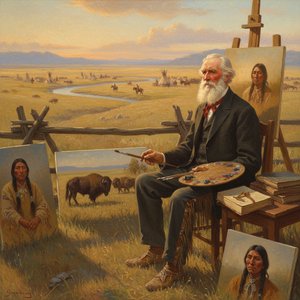
Gabriel Ferrier: A Painter of Exotic Landscapes and Dignified Portraits
Gabriel Joseph Marie Augustin Ferrier (1847 – 1914) stands as a notable figure in French art history, particularly within the Orientalist movement and portraiture during the Third Republic. Born in Nîmes, France, Ferrier’s artistic journey unfolded against the backdrop of Victorian sensibilities and burgeoning European exploration—a period profoundly shaped by fascination with distant lands and cultures. While biographical details remain somewhat sparse, his legacy rests firmly on a prolific output of paintings that capture both breathtaking landscapes and meticulously rendered portraits, cementing his place as an artist who skillfully blended observation and imagination.
- Early Life and Artistic Training:
Ferrier’s formative years were marked by exposure to artistic influences within his family. His father was a sculptor, fostering an early appreciation for visual art and shaping Ferrier's initial artistic inclinations.
- Academic Pursuits and Parisian Salon Recognition:
He pursued formal training at the École Supérieure des Beaux-Arts in Paris, honing his skills under prominent instructors. This rigorous education proved instrumental in establishing him as a respected artist within the Parisian art scene, culminating in repeated successes at the Salon—the official annual exhibition of French artists—where he garnered considerable acclaim for his landscapes and portraits.
Ferrier’s artistic style is characterized by a distinctive blend of realism and expressive color. He meticulously documented exotic locales – notably Algeria – employing techniques honed during extensive expeditions undertaken to capture the grandeur of desert vistas and the vibrancy of Berber life. However, Ferrier wasn't solely devoted to landscape painting; he excelled in portraiture, producing evocative depictions of individuals from various social strata. His portraits are notable for their psychological depth, capturing subtle nuances of emotion and conveying a sense of dignified composure. He skillfully utilized chiaroscuro—the dramatic interplay of light and shadow—to imbue his canvases with atmosphere and to emphasize the contours of his subjects’ faces.
- Notable Paintings:
Among Ferrier's most celebrated works are “Ganymede,” “Moonlit Dreams,” and “Le Serpent (also known as Salammbô).”
"Ganymede," exemplifies his mastery of mythological subject matter, portraying the Greek hero Ganymede with remarkable anatomical accuracy and luminous coloration.
- Influence and Legacy:
Ferrier’s artistic vision aligns closely with the broader Orientalist aesthetic—a genre that sought to portray Eastern cultures through European eyes, often romanticizing them while simultaneously upholding colonial hierarchies.
His meticulous observation of natural detail combined with expressive brushwork contributed significantly to the development of landscape painting during his era, influencing subsequent generations of artists. Furthermore, Ferrier’s portraits continue to resonate today due to their ability to convey profound human emotion and psychological insight—a testament to his enduring artistic talent.
His achievements were recognized by the Académie Royale des Beaux-Arts, where he was awarded a gold medal in 1879 – a prestigious honor that solidified his reputation as one of France’s leading painters. Ferrier's work remains an important record of the visual culture of the Third Republic and exemplifies the artistic spirit of its time. He died peacefully in Paris in 1914, leaving behind a substantial body of paintings that continue to captivate audiences with their beauty and emotional resonance.