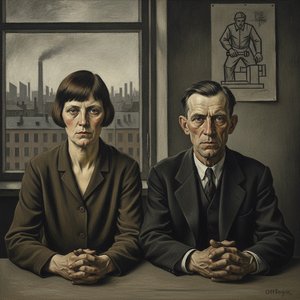
Franz Wilhelm Seiwert, born March 9, 1894, in Cologne, Germany, was a German painter and sculptor whose artistic journey was profoundly shaped by an early trauma. At the tender age of seven, he endured a devastating burn incident in 1901 resulting from experimental radiological treatment—a procedure that instilled within him a pervasive fear of mortality. This formative experience undeniably fueled his creative drive and influenced his artistic vision throughout his life.
artistic career
Seiwert’s formal artistic education commenced at the Cologne School of Arts and Crafts between 1910 and 1914, providing him with foundational skills in drawing and painting. However, it was his encounter with Max Ernst in 1919 that truly ignited his artistic fervor, propelling him into the turbulent realm of Dadaism. He swiftly established his own Dada group, “Stupid,” alongside Ernst, Heinrich Hoerle, and Anton Räderscheidt—a decisive break from Cologne Dada’s more mainstream tendencies as he sought to reconcile constructivism with realism while articulating radical political convictions.
notable exhibitions and contributions
Seiwert's artistic prominence ascended with his inaugural large-scale solo exhibition at the Kunstverein in Cologne in 1923, showcasing his distinctive style and garnering critical acclaim. By the mid-1920s, he emerged as a pivotal figure within “The Group of Progressive Artists,” an ambitious collective dedicated to merging constructivist principles with realist aesthetics—a movement that championed uncompromising political stances. In 1929, Seiwert spearheaded the creation of *A-Z*, a groundbreaking journal devoted to avant-garde art which diligently presented figurative constructivism and actively promoted progressive artistic ideas.
legacy and influence
Franz Wilhelm Seiwert’s indelible mark on the art world remains undeniable. His singular blend of constructivist technique and fervent political activism served as an inspiration for subsequent generations of artists, shaping the trajectory of German art during the interwar period. He stands as a testament to the power of artistic expression as a vehicle for social commentary and intellectual engagement—a legacy that continues to resonate within contemporary discussions about art’s role in confronting societal challenges. His work exemplifies the spirit of experimentation and conviction characteristic of Dadaism and Constructivism, cementing his place among the most influential figures of early 20th-century German art.
Par la rédaction de WahooArt.com
Quiz d'art
Chaque question ne comporte qu'une seule bonne réponse.
Question 1:
Quel mouvement artistique était principalement associé à Franz Wilhelm Seiwert ?
Question 2:
À quel âge Seiwert souffrit d'une brûlure sévère due à un traitement radiologique ?
Question 3:
Quel groupe dada Seiwert forma avec Max Ernst ?
Question 4:
Quel était le principal objectif de la revue « A-Z » fondée par Seiwert ?
Explore the profound impact of Constructivism on modern art. Discover how geometric abstraction and industrial aesthetics revolutionized design, from avant-garde textiles to architectural mastery, curated for the discerning art collector seeking depth and historical significance.
Explore the raw emotion of German Expressionism through a definitive guide to Ernst Ludwig Kirchner. Discover how his bold colors and distorted forms redefined modern art history, from Berlin street scenes to iconic masterpieces.
Bonjour ! Je peux vous aider à choisir une œuvre d'art, à suivre une commande ou à répondre à vos questions sur la garantie. Comment puis-je vous aider ?