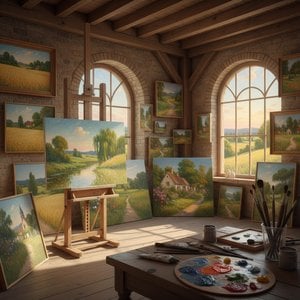
The Soul of Lake Geneva: The Life and Legacy of François Bocion
François Bocion (1828–1890) was far more than a mere chronicler of the Swiss landscape; he was a poet of light and atmosphere, a painter who possessed the rare ability to translate the ephemeral whispers of nature onto canvas. Born in Lausanne, his early life was marked by both profound beauty and sudden hardship. Following the untimely death of his father, a carpenter, young François found himself under the care of his grandfather, a marble sculptor in Montreux. This early immersion in the tactile world of sculpture likely instilled in him a foundational respect for form and texture, even as his heart drifted toward the fluid, luminous realms of painting. His formative years in Switzerland, surrounded by the majestic peaks and the shimmering expanse of Lake Geneva, provided the eternal muse that would define his entire artistic journey.
As he matured, Bocion’s gaze turned toward Paris, the beating heart of the nineteenth-century art world. Arriving in 1846, he entered a vibrant crucible of innovation where the rigid structures of academicism were beginning to yield to the revolutionary spirit of Impressionism. Under the profound influence of Jean-Baptiste Camille Corot, Bocion learned the delicate art of tonal harmony and the mastery of atmospheric perspective. He did not merely paint what he saw; he painted how the light felt as it danced across a surface. His time in Paris was further enriched by close associations with luminaries such as Charles Gleyre and Louis-Aimé Grosclaude, creating a collaborative environment that allowed him to experiment with the loose brushstrokes and subtle color palettes that would become his signature.
A Mastery of Light and Landscape
The true essence of Bocion’s oeuvre lies in his breathtaking depictions of the Lake Geneva region. His landscapes are characterized by an exquisite balance between realism and romanticism, where the physical details of a shoreline or a passing barge are imbued with a deep, emotional resonance. In works such as 'Lake Geneva with Sailing Boats', one can sense the gentle movement of the water and the soft, hazy light of a summer afternoon. He utilized a technique that favored subtle transitions of color, allowing the mountains to recede into misty blues while bringing the immediate foreground into sharp, luminous focus. This mastery of light allowed him to capture not just the geography of Switzerland, but its very spirit—a sense of serene permanence intertwined with the fleeting beauty of a single moment.
Beyond his landscapes, Bocion was a versatile creator whose talents extended into design and illustration. His role as a Professor of Drawing at the École industrielle de Lausanne allowed him to shape the aesthetic sensibilities of future generations, ensuring that his commitment to artistic excellence would endure. He even contributed satirical cartoons to the journal La Guêpe, demonstrating a wit and versatility that complemented his more serious landscape pursuits. Whether he was capturing the geometric detail of a canal in 'A Barge' or the romanticized figures on a lakeshore, his work remained anchored in a humanist sensibility—a profound connection to the lived experience of the natural world.
Historical Significance and Enduring Impression
The historical importance of François Bocion rests in his role as a bridge between the classical traditions of his mentors and the burgeoning Impressionist movement. He was a pivotal figure in the Swiss art scene, fostering a generation of painters and establishing a visual language for the region that remains iconic to this day. His ability to integrate the structural lessons of Corot with the light-centric innovations of the mid-century era allowed him to create works that feel both timeless and modern.
Today, the legacy of Bocion lives on through his presence in prestigious collections such as the Musée d'Orsay and the Musée des Beaux-Arts de Strasbourg. His paintings serve as windows into a nineteenth-century Switzerland that was both tranquil and undergoing profound artistic transformation. To look upon a Bocion landscape is to experience a moment of quiet contemplation, a reminder of the enduring power of nature to inspire the human soul through the delicate medium of paint.
Key Influences: Jean-Baptiste Camille Corot, Charles Gleyre, and Louis-Aimé Grosclaude.
Primary Subject Matter: The landscapes of Lake Geneva, Swiss canals, and atmospheric maritime scenes.
Artistic Style: Impressionistic tendencies, characterized by tonal harmony, loose brushwork, and light-driven compositions.
Notable Roles: Painter, Designer, Art Professor, and Illustrator.
Par la rédaction de WahooArt.com
Quiz d'art
Chaque question ne comporte qu'une seule bonne réponse.
Question 1:
What artistic movement is François Bocion primarily associated with?
Question 2:
Where did Bocion study art before moving to Paris?
Question 3:
What role did Bocion play in fostering the artistic development of younger Swiss painters?
Question 4:
François Bocion’s landscapes often depict...
Question 5:
In what year did François Bocion secure a professorship at the Lausanne École industrielle?
Discover the profound emotional depth of Post-Impressionist landscapes. Explore how masters like Van Gogh revolutionized art through vibrant color, textured impasto, and symbolic expression in this expert guide to the movement that redefined modern art history.
Discover the profound tranquility of rural art through an expert exploration of Impressionist landscapes. From pastoral scenes to textured oil masterpieces, learn how timeless nature-inspired artworks bring enduring elegance and serenity to sophisticated collectors.
Explore the ethereal beauty of Impressionist landscapes. Discover how masters like Monet captured fleeting light through color and texture, and learn to curate these timeless, luminous masterpieces for your home collection.
Bonjour ! Je peux vous aider à choisir une œuvre d'art, à suivre une commande ou à répondre à vos questions sur la garantie. Comment puis-je vous aider ?