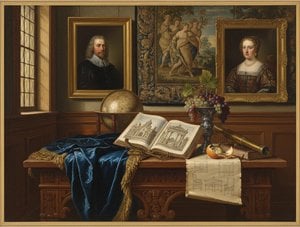
Francisco Camilo (1615 – 1673): A Florentine Soul Embraced by Spanish Baroque
Francisco Camilo, born in Madrid in 1615, stands as a beacon of artistic convergence—a remarkable embodiment of the vibrant spirit of the Spanish Baroque. His father, Domenico Camilo, was an Italian painter who had established himself in Madrid, bringing with him traditions deeply rooted in Florentine Mannerism and humanist ideals. This heritage profoundly shaped Camilo’s artistic vision, nurturing a meticulous attention to detail and fostering a profound understanding of anatomy and perspective; it ensured that his art would resonate with the intellectual currents of its time.
Early Training & Patronage: The Foundations of Skill
Camilo's formative education unfolded under the watchful eye of Pedro de las Cuevas, a celebrated Madrid painter who championed the principles of academic painting. This invaluable mentorship equipped Camilo with the technical prowess demanded by the competitive artistic milieu of Madrid, guaranteeing him mastery over perspective and anatomical accuracy—skills crucial for capturing the grandeur and emotion inherent in Baroque art.
The Jesuit Influence: Drama and Devotion
A transformative moment arrived when Camilo accepted a commission to decorate the high altar of the Jesuits’ house at Madrid – an undertaking that plunged him into the fervent spiritual atmosphere and stylistic innovations characteristic of Jesuit art. The resulting depiction of Saint Francis Borgia exemplifies the Baroque fascination with dramatic composition and emotive expression, skillfully conveying religious fervor through masterful use of color and light. It remains a testament to Camilo's ability to translate theological concepts into visual splendor.
Royal Commissions & Artistic Flourishing: Majesty Embodied
Camilo’s reputation swiftly ascended as he secured prestigious commissions from the Count-Duke of Olivares—the dominant political force in Spain during his era – securing royal patronage and elevating him to prominence within the artistic circles of Madrid. Among these were a series of portraits of Spanish monarchs, showcasing Camilo’s unparalleled skill in portraiture and demonstrating his capacity to imbue regal dignity and authority into each canvas. These works solidified his position as one of the foremost artists of his time.
The Theater of Buenretiro & Ovids Metamorphoses: A Monumental Vision
Perhaps Camilo's most ambitious endeavor was the decoration of the western gallery of the Palace of Buenretiro – a colossal project featuring fourteen frescoes inspired by Ovid’s *Metamorphoses*. These canvases represent a daring exploration of narrative storytelling, demonstrating Camilo’s artistic ingenuity and his willingness to tackle complex mythological tales with imaginative flair. The frescoes are considered masterpieces of Baroque art, reflecting Camilo's commitment to elevating the visual arts as vehicles for conveying profound philosophical ideas.
Legacy & Enduring Influence
Though Camilo’s output has diminished in visibility over time, scholars recognize his significance as a pivotal figure in Spanish Baroque art—a conduit for humanist ideals and artistic innovation. His meticulous technique – characterized by precise observation and skillful rendering – continues to inspire admiration and serves as a poignant reminder of the splendor achieved during Spain's golden age. Francisco Camilo’s enduring legacy resides not merely in his individual artworks but also in his contribution to shaping the aesthetic sensibilities of an entire era.