La Vision Sculpturale de Francesco Mochi
Francesco Mochi s'impose comme une figure singulière de la sculpture italienne du XVIIe siècle, reconnu non seulement pour sa production prolifique, mais aussi pour sa contribution profonde à l'établissement de l'esthétique baroque. Né à Montevarchi, en Toscane, en 1580, il entreprit un voyage artistique traversant Florence et Rome, aboutissant à un héritage défini par une émotion dramatique et une technique magistrale. Son œuvre sert de pont vital entre l'élégance structurée de la fin de la Renaissance et la grandeur explosive et théâtrale de l'ère baroque, préfigurant le style monumental que Gian Lorenzo Bernini perfectionnera plus tard.
Les années de formation de Mochi furent façonnées par les traditions rigoureuses de l'art florentin. Sous la tutelle du peintre Santi di Tito, il adopta le principe du disegno—la primauté de la ligne et de la forme. Cette formation lui inculqua une appréciation fondamentale pour l'harmonie visuelle et la rigueur intellectuelle, reflétant la clartée sculpturale propre à l'atelier de Giambologna. Si son exposition précoce à la peinture lui permit d'acquérir une compréhension profonde de la composition, c'est sa transition vers le domaine tridimensionnel qui lui permit de traduire ces principes classiques en une pierre et un bronze dynamiques et vibrants.
Une Ascension Romaine et la Naissance du Drame Baroque
Vers 1599, Mochi s'installa à Rome, s'immergeant dans un milieu artistique vibrant favorisé par la puissante famille Farnèse. Au sein de l'atelier de Camillo Mariani, il affina sa compréhension de la texture et du mouvement, mais c'est son lien avec le cercle de Pietro Bernini qui catalysa véritablement son évolution. Cette association le plaça au cœur même de la ferveur artistique naissante à Rome, l'exposant aux innovations stylistiques qui allaient bientôt redéfinir l'art occidental. Mochi commença à s'éloigner des compositions statiques pour embrasser un sentiment de mouvement capturé et une profondeur psychologique.
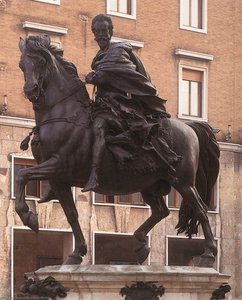
Sa maîtrise fut plus évidente encore dans sa capacité à manipuler la matière et la lumière. En tant que maître de la fonte du bronze, il atteignit un niveau de détail qui insufflait la vie au métal, comme en témoigne son emblématique Statue équestre d'Alessandro Farnèse. Ce chef-d'œuvre de 1620 reflète à la fois la puissance de la Renaissance et une nouvelle virtuosité artistique, capturant la présence imposante du sujet à travers des lignes fluides et un sentiment de mouvement imminent. Son travail durant cette période démontre une capacité profonde à équilibrer la dignité classique avec l'intensité émotionnelle qui caractérise le début du Baroque.
Héritage et Chefs-d'œuvre Éternels
Le zénith de la carrière de Mochi est peut-être le mieux incarné par ses contributions aux espaces les plus sacrés de la chrétienté. Sa sculpture de Sainte Véronique, située au sein de la basilique Saint-Pierre, demeure un témoignage poignant de sa capacité à évoquer une compassion profonde. Dans cette œuvre, l'instant de la création du voile est capturé avec une telle dévotion et une telle tendresse qu'il transcende la simple pierre, invitant le spectateur dans un moment de rencontre divine. Cette capacité de narration spirituelle, alliée à une virtuosité technique, lui assura une place parmi les plus grands sculpteurs de son temps.
Tout au long de sa vie, les accomplissements de Mochi ont laissé une marque indélébile sur la trajectoire de la sculpture européenne. Sa carrière fut jalonnée par plusieurs étapes clés :
- La fusion des styles : Un mélange réussi du disegno florentin et de la théâtralité romaine.
- L'innovation technique : Le perfectionnement de l'art de la fonte du bronze pour atteindre un détail expressif sans précédent.
- La reconnaissance papale : L'obtention de commandes prestigieuses plaçant son œuvre au centre du pouvoir religieux et politique.
- L'influence historique : Un rôle de précurseur crucial pour le Baroque tardif, ouvrant la voie à la génération suivante de maîtres.
Même dans ses œuvres plus intimes, telles que le Buste d'un jeune homme, Mochi démontra une aptitude à capturer la beauté classique à travers le prisme d'une vitalité moderne. Son héritage ne se trouve pas seulement dans les monuments qui portent son nom, mais dans le langage même du mouvement et de l'émotion qui continue de définir l'esprit baroque.