Francesco Botticini: A Florentine Master Rediscovered
Francesco di Giovanni Botticini (c. 1446 – January 16, 1498) stands as a testament to the quiet brilliance of early Renaissance painting—a figure whose impact on Florentine art history has only recently been fully appreciated thanks to meticulous scholarship and the painstaking reconstruction of his oeuvre. While overshadowed by contemporaries like Leonardo da Vinci and Michelangelo during his lifetime, Botticini’s output represents a substantial contribution to the artistic landscape of his era, characterized by masterful technique and profound spiritual contemplation.Early Life and Artistic Training
Born in Florence around 1446—precise dates remain elusive—Botticini descended from a family with established artistic traditions. His father, Giovanni di Domenico di Piero, was himself a painter, fostering an environment conducive to artistic pursuits. Crucially, Botticini’s formative years coincided with the ascendancy of Neri di Bicci, arguably Florence's most influential workshop master at the time. Recognizing his talent early on, Bicci apprenticed Botticini in 1459, securing him a position within a vibrant hub of artistic innovation. This association proved invaluable, exposing Botticini to the stylistic precepts and collaborative spirit that defined Bicci’s studio—a crucible for shaping the sensibilities of future masters. Though his tenure was brief, lasting only nine months before he departed Bicci's workshop in 1460, Botticini’s time under Bicci instilled a foundational understanding of fresco painting and humanist artistic ideals. He learned to blend color with meticulous detail, mastering techniques that would become hallmarks of his distinctive style. Following his departure from Bicci’s workshop, Botticini embarked on a period of intensive study within the atelier of Andrea del Verrocchio—a legendary sculptor and painter who served as mentor to Leonardo da Vinci among others. This immersion in Verrocchio's workshop provided Botticini with unparalleled exposure to sculptural techniques alongside painting, broadening his artistic horizons and solidifying his mastery of illusionistic perspective. The collaborative atmosphere fostered by Verrocchio undoubtedly influenced Botticini’s stylistic choices, contributing to the distinctive visual language that characterizes his paintings. He honed his skills in creating realistic figures and conveying emotion through subtle gestures—a legacy inherited from Verrocchio's groundbreaking approach to artmaking.Botticini’s Artistic Style and Notable Works
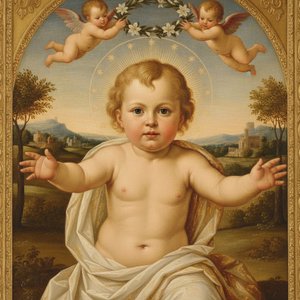
Botticini's artistic style is immediately recognizable for its luminous color palette—particularly its use of ultramarine pigment—and its meticulous attention to detail. He excelled in portraying religious subjects with a serene grace and psychological depth, prioritizing emotional resonance over dramatic gesture. His paintings frequently depict scenes from the Gospels and biblical narratives, imbued with symbolic significance and conveying profound spiritual contemplation. Among Botticini’s most celebrated achievements are undoubtedly ‘Assumption of the Virgin,’ housed in Siena Cathedral—a monumental altarpiece showcasing Botticini's unparalleled skill in fresco painting and his masterful manipulation of color and light—and ‘Sacrament Tabernacle,’ a breathtaking depiction of Christ’s ascension, demonstrating Botticini’s mastery of spatial illusionism. Furthermore, he produced iconic works such as 'Saint Sebastian,' reflecting the humanist ideals prevalent in Florentine art during his time. His compositions are characterized by balanced symmetry and harmonious color schemes—a testament to his unwavering dedication to artistic excellence.Influences and Legacy
Botticini’s artistic development was profoundly shaped by the stylistic currents of his era, drawing inspiration from Giotto di Bondone's expressive frescoes and embracing innovations championed by Filippo Brunelleschi. However, his formative years were particularly influential in establishing him as a student under Andrea del Verrocchio—a sculptor whose mastery of realism and humanist ideals served as a cornerstone for Botticini’s artistic vision. This mentorship instilled within Botticini an understanding of sculptural techniques alongside painting, broadening his artistic horizons and solidifying his commitment to conveying emotion through visual representation. His work stands as a pivotal bridge between Byzantine tradition and the burgeoning Renaissance—a testament to the transformative power of artistic exchange and innovation. Botticini’s enduring legacy resides not merely in his stunning visual achievements but also in his role as a catalyst for shaping Florentine art history during its golden age—a testament to the transformative power of quiet dedication and unwavering artistic vision. He remains an exemplar of understated elegance and profound spiritual sensitivity, whose paintings continue to captivate audiences today with their luminous colors and masterful execution.Questions et réponses
Puis-je visiter un musée virtuel des œuvres de Francesco Botticini ?
Retrouvez les œuvres de Francesco Botticini dans une galerie 3D sur la page Musée en 3D de l'artiste.
Existe-t-il un aperçu de tous les sujets peints par Francesco Botticini ?
La page Index thématique répertorie les œuvres de Francesco Botticini par sujet.
Dans quels mouvements Francesco Botticini a-t-il travaillé ?
Retrouvez les mouvements associés à Francesco Botticini sur la page Tous les mouvements artistiques de l'artiste, qui regroupe ses œuvres par mouvement.