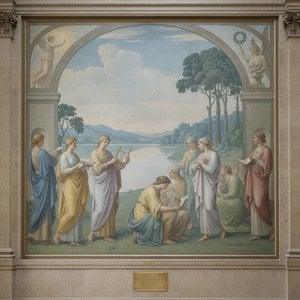
Filipe de Sousa Folque: Cartographer of Portugal’s Soul
Filipe de Sousa Folque (1800-1874) stands as a pivotal figure in Portuguese history, not merely for his aristocratic lineage and political involvement—though undeniably influential—but primarily for his groundbreaking contribution to the art of cartography. Born in Portalegre, Portugal, Folque’s life unfolded against the backdrop of a nation undergoing significant transformation during the Romantic era, shaping him into an engineer, mathematician, military officer, and above all, a meticulous observer of the physical world. His legacy resides not just in his formal titles but in the enduring impact of his maps—particularly the ‘Atlas of Lisboa,’ which remains a cornerstone of Lisbon’s visual heritage.
Early Life & Education: The Seeds of Precision
Folque's upbringing instilled in him a deep appreciation for precision and observation, qualities that would serve as foundational elements in his future endeavors. Educated at Coimbra University—a bastion of Enlightenment ideals—he excelled in mathematics, securing a degree that underpinned his analytical approach to surveying and mapmaking. This intellectual grounding wouldn’t merely inform his scientific pursuits; it fostered a worldview characterized by meticulous detail and an unwavering commitment to accurate representation – principles that would permeate every aspect of his subsequent career.
Military Service & Engineering Career: Shaping Portugal's Landscape
Folque’s military service began with service in the Armada, followed by appointments within the Ministry of Works. This experience honed his technical skills and exposed him to the challenges of practical engineering projects—a discipline he embraced wholeheartedly. Notably, he spearheaded the establishment of the Course of Engineer Hydrographer at the Academia Portuguesa, recognizing the importance of specialized knowledge for charting Portugal’s coastline. His dedication to advancing Portuguese science and technology cemented his reputation as a visionary leader and solidified his role in shaping the nation's infrastructural development.
The Atlas of Lisboa: A Triumph of Vision & Technique
Folque's magnum opus is undoubtedly the ‘Atlas of Lisboa,’ completed in 1860. Commissioned by King Luís I, this ambitious project aimed to comprehensively document Lisbon’s topography—a task that demanded unprecedented accuracy and artistic skill. Utilizing innovative techniques honed during his travels abroad – notably stereoscopic projection and meticulous measurement – Folque employed cutting-edge methods to create a map unlike any seen before. It wasn't simply a representation of the city; it was an attempt to capture its essence, reflecting the grandeur of its palaces and the dynamism of its urban life. The resulting atlas stands as a testament to Folque’s unwavering belief in the power of observation combined with artistic interpretation—a legacy that continues to inspire scholars and artists alike.
Influence & Historical Significance: A Pioneer's Enduring Legacy
Folque’s work profoundly impacted Portuguese cartography and influenced subsequent generations of surveyors and artists. His insistence on scientific rigor combined with artistic sensitivity established a precedent for future mapmakers – a blend that continues to resonate in contemporary explorations of visual representation and spatial understanding. Moreover, the ‘Atlas of Lisboa,’ now housed in the Museu Nacional da Ajuda, serves as an enduring symbol of Portugal’s intellectual heritage—a tangible reminder of Folque's singular contribution to the nation’s artistic and scientific advancement. He died peacefully in Lisbon on December 27, 1874, leaving behind a legacy that transcends time and continues to captivate those who appreciate the beauty and power of meticulous observation.
Sources: Wikipedia, Geographicus Rare Antique Maps
Par la rédaction de WahooArt.com
Quiz d'art
Chaque question ne comporte qu'une seule bonne réponse.
Question 1:
Quel était le domaine principal des contributions de Filipe Folque ?
Question 2:
À quel ministère Folque a-t-il servi au début de sa carrière militaire ?
Question 3:
Dans quelle université Folque a-t-il obtenu son diplôme en mathématiques ?
Question 4:
Quel était le rôle spécifique de Folque dans la création du Cours d’Ingénieur Hydrographe à l’Académie Portugaise ?
Explore the life & work of Pierre Puvis de Chavannes, a pivotal Symbolist painter renowned for his monumental murals. Discover his aesthetic principles, key artworks like 'Hope,' and lasting influence on modern art. A deep dive into 19th-century French painting.
Plongez au cœur de l'œuvre inégalable de Goya ! Découvrez 25 chefs-d’œuvre emblématiques, des portraits saisissants aux scènes dramatiques. Explorez la vie et l'art du maître espagnol avec WahooArt.com – reproductions d'art de qualité musée et inspirations déco.
Discover Alfredo Roque Gameiro (1864-1935), a renowned Portuguese painter celebrated for his vibrant watercolors and historical illustrations. Explore his legacy & artworks at WahooArt.
Bonjour ! Je peux vous aider à choisir une œuvre d'art, à suivre une commande ou à répondre à vos questions sur la garantie. Comment puis-je vous aider ?