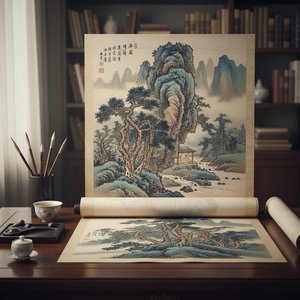
Fang Shishu (1692 – 1751): A Master of Tranquil Landscape Painting
Fang Shishu, born in Xin’an County, Anhui Province during the Qing Dynasty (1644–1911), stands as a pivotal figure in Chinese landscape painting—specifically within the Wang Meng School tradition. His artistic legacy is characterized by serene compositions imbued with profound philosophical contemplation and meticulous brushwork that captures the essence of nature's beauty. Understanding Shishu’s life and oeuvre requires delving into the cultural milieu of his time, shaped by Confucian ideals emphasizing harmony between humanity and the cosmos.
Early Life and Artistic Training
Little biographical information survives about Fang Shishu’s formative years. He emerged as a painter during the reign of Yongzheng (1722–1735), demonstrating exceptional talent from an early age. While precise details regarding his formal training remain elusive, it is believed he studied under prominent Wang Meng artists—a movement that championed simplicity and restraint in portraying mountainous landscapes—further cementing Shishu’s stylistic approach. The Wang Meng School prioritized capturing the spirit of mountains and rivers rather than merely replicating their visual appearance, reflecting a broader philosophical preoccupation with achieving inner peace through contemplation of natural grandeur.
Style and Technique: Embracing Tranquility and Detail
Shishu's distinctive style is immediately recognizable by its profound stillness and subtle tonal variations—a hallmark of Wang Meng’s aesthetic. Unlike more exuberant depictions prevalent during the Qianlong period, Shishu favored muted hues and understated brushstrokes that conveyed a sense of quiet contemplation. His landscapes are meticulously rendered with painstaking attention to detail, capturing textures like moss-covered rocks, misty peaks, and flowing streams. He skillfully employed layering techniques—known as *gongbi*—to build up tonal gradations and create atmospheric depth, mirroring the philosophical concept of ‘wu wei’ – effortless action—which underpinned Wang Meng's artistic vision. The artist’s signature inscription eloquently encapsulates this ethos: “趙令穰每一落筆,靜秀之光撲人鬚面,而論者猶以不讀書少之。夫讀書何也?以通于畫也,或告我曰“能讀書人,于天地化工之氣、山川性情之愛,無所不見。於古今崎嶇歴落之事,禽鳥花月之魂,天寒嵗暮之愁,俱有所欣感,排宕而出,而出者不知也”。然則“讀書”二字,豈徒一畫理為然哉?環山方士庶印 環山 洵遠摹古 – “Every brushstroke radiates serene beauty onto one’s face, and those who contemplate it lack the wisdom of reading books. Why read books? It is to understand the essence of heaven and earth, alchemy, and the love for mountains and rivers. One sees everything from the rugged paths of ancient times to the souls of birds and flowers, the sorrows of winter and dusk; one rejoices at what emerges, and he who emerges does not know why. Yet ‘reading’ is more than just a brushstroke—it illuminates the spirit of the mountain.” This inscription underscores Shishu's belief that painting transcends mere representation, embodying a deeper understanding of nature and human experience.
His landscapes often depict serene vistas bathed in misty light, reflecting the influence of Wang Meng’s artistic sensibilities. Recurring motifs include pine trees symbolizing longevity and resilience, rocks representing stability and permanence, and flowing streams conveying dynamism and vitality—elements carefully chosen to convey profound philosophical ideas. Shishu's meticulous brushwork demonstrates an exceptional command of technique, capturing subtle nuances of color and texture with remarkable precision. He skillfully utilized *qiang hua* – bold strokes—to delineate mountain peaks and create dramatic visual impact while simultaneously employing delicate washes—known as *hua qi*—to soften contours and evoke atmospheric depth.
Fang Shishu’s artistic journey began in Xin'an (now Shexian), Anhui Province, where he was born into a family steeped in literary tradition. His father, Fang Zhongshu, was a prominent scholar and administrator who instilled in him a lifelong passion for calligraphy and painting—a heritage that would profoundly shape his creative output. Early influences included Wang Meng’s landscape paintings, which championed the concept of “empty mountain” aesthetics—a style characterized by understated beauty and profound contemplation. This aesthetic resonated deeply with Shishu's own artistic vision, guiding him to prioritize harmony between man and nature and conveying a sense of spiritual serenity.
Shishu’s oeuvre comprises approximately 150 paintings, predominantly landscapes executed in ink wash technique. His works are distinguished by their exceptional realism combined with an expressive quality that transcends mere visual depiction. He meticulously observed the subtleties of light and shadow, capturing the textures of rocks, trees, and water surfaces with astonishing accuracy—a testament to his mastery of brushwork and compositional principles. Recurring themes explore the grandeur of mountainous scenery, reflecting Shishu’s admiration for the sublime beauty of the natural world. His paintings often depict misty valleys, towering peaks shrouded in clouds, and tranquil lakes mirroring the sky—creating immersive environments that invite viewers into a meditative state.
Among Shishu's most celebrated achievements is his contribution to Wang Meng’s landscape style, which emerged as a dominant force in Qing Dynasty art. He skillfully adopted Wang Meng’s techniques of simplification and abstraction, conveying profound emotional resonance through subtle tonal variations and understated brushstrokes—a stylistic innovation that cemented his reputation as one of the era's foremost painters. His paintings exemplify the “empty mountain” aesthetic—characterized by minimal ornamentation and a focus on capturing the essence of nature—reflecting Shishu’s belief in the importance of cultivating inner harmony and appreciating the beauty of simplicity.
Shishu’s legacy extends beyond his artistic accomplishments, influencing subsequent generations of Chinese landscape painters. His meticulous observation of natural phenomena and his masterful execution of ink wash technique served as inspiration for artists striving to emulate Wang Meng's style—establishing him as a pivotal figure in Qing Dynasty art history. Furthermore, Shishu’s unwavering commitment to conveying spiritual contemplation through visual imagery solidified the role of landscape painting as a vehicle for philosophical expression—a tradition that continues to resonate within Chinese artistic culture today. His paintings stand as enduring symbols of aesthetic refinement and contemplative serenity, embodying the profound connection between humanity and the natural world.