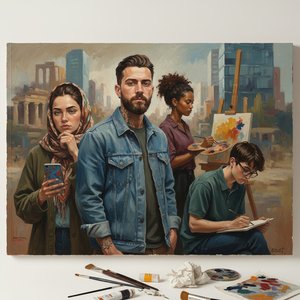
CONSEIL EN ART GRATUIT

x

Eunil Lee

Informations clés

  • Top-ranked work: Eunilee
  • Born: 1983, Incheon, Corée du Sud
  • Art period: Contemporain
  • Top 3 works: Eunilee
  • Plus…
  • Copyright status: Under copyright
  • Nationality: Corée du Sud
  • Works on APS: 1
  • Museums on APS:
    • Gwangju Design Biennale
    • Gwangju Design Biennale
    • Gwangju Design Biennale
    • Gwangju Design Biennale
    • Gwangju Design Biennale

Quiz d'art

Chaque question ne comporte qu'une seule bonne réponse.

Question 1:
Quelle est la principale formation scientifique d’Eunil Lee ?
Question 2:
Eunil Lee tient un doctorat de quelle université ?
Question 3:
Au-delà de la peinture, Eunil Lee a poursuivi des activités dans :
Question 4:
Le style artistique d’Eunil Lee est caractérisé par :
Question 5:
Quel projet artistique remarquable Eunil Lee a-t-elle contribué à ?

Eunil Lee: Bridging Tradition and Innovation in Contemporary Landscape Painting

Born in Incheon, South Korea (1983), Eunil Lee’s artistic journey began with a grounding in scientific inquiry – earning a PhD in Environmental Toxicology from Seoul National University – yet swiftly blossomed into a fervent dedication to visual expression. This dual perspective profoundly shapes her oeuvre, characterized by vibrant palettes and dynamic compositions that honor Korean artistic heritage while embracing the dynamism of modern aesthetics. Her formative years witnessed exposure to both Eastern and Western art traditions, cultivating an appreciation for diverse stylistic approaches. Notably, Lee pursued postgraduate studies at Korea University, focusing on research and contributing scholarly publications concerning environmental health – demonstrating a remarkable intellectual curiosity extending beyond purely visual pursuits. However, it is her artistic practice itself that distinguishes Lee’s contribution to Korean contemporary art; she skillfully integrates techniques derived from Oriental painting with inventive methods for conveying the essence of landscapes and urban environments. A pivotal influence on Lee's artistic trajectory was the pioneering work of Lee Ungno (1897-1980), a Korean master painter whose Abstract Letter series captivated audiences globally. Ungno’s audacious exploration of expressive abstraction – utilizing bold colors and simplified forms to communicate emotion and spiritual depth – instilled in Lee a conviction to challenge conventions and experiment with unorthodox techniques. This connection to Ungno's groundbreaking achievement underscores Lee’s unwavering commitment to pushing artistic boundaries and forging new paths within Korean painting tradition. Lee’s distinctive style isn’t merely about replicating visual reality; it delves into psychological states and emotional resonance. Her paintings aren’t simply representations of places but rather conduits for conveying feelings—a testament to her belief that art possesses the power to communicate intangible experiences. This introspective dimension aligns with broader trends in contemporary art, where artists grapple with complex themes of identity, memory, and perception. Recent exhibitions showcasing Lee's work have garnered critical acclaim, establishing her reputation as a significant voice within the Korean artistic community. Furthermore, she’s ventured into diverse creative fields – including game design (Ghost Recon Breakpoint) – demonstrating versatility and expanding her artistic horizons beyond traditional painting mediums. Her involvement in these projects underscores her commitment to innovation and her willingness to engage with new forms of storytelling and visual communication. Lee's work has been recognized internationally, notably featured at the U.S. Department of the Interior Museum where her paintings contribute to a broader narrative about American landscapes and cultural heritage. This recognition speaks volumes about the universality of Lee’s artistic vision—a vision that transcends geographical boundaries and resonates with audiences across cultures. Eunil Lee continues to inspire artists and scholars alike, solidifying her place as a pivotal figure in shaping the future of Korean art and its engagement with global dialogues.