Eugène Laermans: A Visionary of Marginal Lives
Eugène Jules Joseph Baron Laermans (1864-1940) stands as a singular figure in Belgian art history—a painter who wrestled with deafness and blindness, yet relentlessly pursued an uncompromising vision of social realism. Born in Sint-jans-molenbeek, Brussels, his early life was marked by tragedy; meningitis at the age of eleven robbed him of hearing and nearly silenced his voice, profoundly shaping his artistic trajectory. Rather than retreating from the world, Laermans turned his gaze outwards, honing his observational skills and dedicating himself to capturing the dignity and hardship of ordinary laborers and impoverished peasants—a preoccupation that would define his oeuvre for decades.- Early Life & Deafness: Diagnosed with meningitis as a child, Laermans’ deafness instilled in him an acute sensitivity to visual perception. This formative experience fueled his determination to become a painter, prioritizing sight above all else. He endured considerable hardship during his youth, facing challenges that would test his resolve and inspire his artistic empathy.
- Academic Training & Influences: He enrolled at the Académie royale des beaux-arts in Brussels under Jean-François Portaels, absorbing stylistic lessons from Portaels and developing a deep admiration for Félicien Rops’ expressive landscapes. Equally significant were the writings of Charles Baudelaire, whose decadent aesthetic resonated with Laermans' artistic sensibilities—a connection that would inform his exploration of darker themes and psychological complexities.
- The Decadent Movement & Baudelaire’s Influence: Embracing the tenets of decadence in 1890, Laermans actively participated in the movement and illustrated Baudelaire’s controversial “Les Fleurs du Mal,” demonstrating his willingness to confront uncomfortable truths about human nature. This bold artistic choice reflected a desire to challenge societal conventions and provoke intellectual debate.
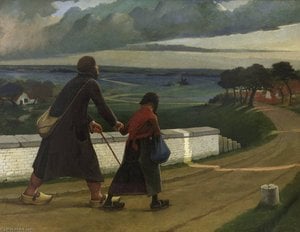
- Genre Painting & Social Commentary: Laermans’ paintings are notable for their meticulous observation of everyday life, capturing the textures and nuances of rural poverty with remarkable accuracy. His depictions challenged prevailing social norms and provoked contemplation on human suffering—a commitment that underpinned his artistic vision throughout his career.
- Illustrations & Notable Projects: He gained recognition as an illustrator, notably contributing to Georges Eekhoud's novel “La Nouvelle Carthage” and embarking on a monumental triptych titled "Landverhuisers" (Emigrants)—a project he considered his magnum opus, reflecting his unwavering commitment to portraying the human condition. This ambitious undertaking showcased Laermans’ technical prowess and artistic ambition.
- Recognition & Legacy: Laermans’ enduring legacy resides in his unflinching portrayal of human dignity amidst adversity—a testament to the power of art to illuminate social injustices and inspire compassion. His work continues to resonate with audiences today, prompting reflection on themes of vulnerability, resilience, and the importance of confronting uncomfortable realities.
- The “Laermansmuur” & Community Spirit: A local wall in Wemmel bears witness to Laermans’ generosity as a young man, saving a drowning swimmer—a gesture that cemented his place in the collective memory of Brussels and embodies the artist’s humanist values.
Questions et réponses
D'où vient Eugène Laermans ?
Eugène Laermans est né(e) en Belgique.
Dans quels mouvements Eugène Laermans a-t-il travaillé ?
Les œuvres de Eugène Laermans peuvent être consultées par mouvement sur la page Tous les mouvements de l'artiste.
Où puis-je voir les œuvres de Eugène Laermans classées par atmosphère ?
La L'ambiance par émotion de Eugène Laermans est une page qui organise les œuvres de l'artiste par ambiance.
Puis-je parcourir les œuvres de Eugène Laermans par technique ?
La page Tous les médiums regroupe les œuvres de Eugène Laermans par technique.
Où et en quelle année Eugène Laermans est-il né ?
Eugène Laermans est né à Saint-Jean, Bruxelles en 1864.
Dans quelle ville et quel pays Eugène Laermans est-il/elle né(e) ?
Eugène Laermans est né à Saint-Jean, Bruxelles, en Belgique.
Puis-je visiter un musée virtuel des œuvres de Eugène Laermans ?
Les œuvres de Eugène Laermans sont visibles dans une galerie 3D sur la page Musée 3D de l'artiste.