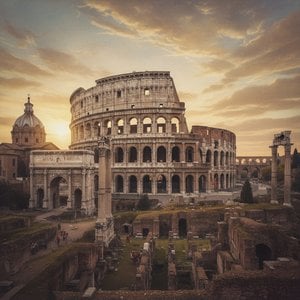
Étienne Dupérac : L'Architecte d'une Vision Romaine
Étienne Dupérac (v. 1525 – 1604), né à Bordeaux, s'impose comme une figure charnière du paysage artistique de la Renaissance, particulièrement célèbre pour ses contributions à l'illustration architecturale et aux cartes topographiques de la Rome antique. Bien que parfois éclipsé par des contemporains tels que Michel-Ange ou Raphaël, les rendus méticuleux de Dupérac ont capturé la grandeur et la complexité des monuments romains avec une précision inégalée — un véritable témoignage de son dévouement et de son talent en tant qu'orfèvre de la gravure, peintre, architecte et cartographe. Son héritage ne réside pas seulement dans ses œuvres individuelles, mais dans l'établissement d'un nouveau standard de représentation visuelle à une époque habitée par l'obsession des idéaux classiques.- Jeunesse et Formation : Les années formatrices de Dupérac furent consacrées au perfectionnement de ses talents sous la tutelle de Jean Goujon, célèbre sculpteur et architecte qui fut le fervent défenseur de la renaissance des styles architecturaux romains. Ce mentorat a instillé chez Dupérac une profonde appréciation des formes et des techniques classiques, pierre angulaire de son œuvre ultérieure.
- Rome et l'Illustration Architecturale : L'arrivée de Dupérac à Rome vers 1559 marqua un tournant décisif dans sa carrière, le propulsant au cœur même de l'innovation artistique. Il gagna rapidement une reconnaissance en tant qu'illustrate et concepteur de plans architecturaux, produisant des représentations époustouflantes de temples, de basiliques et d'espaces publics — des ouvrages qui servirent de guides inestimables pour les érudits comme pour les architectes.
- Projets Notables : La production prolifique de Dupérac engloba des entreprises ambitieuses telles que le Speculum Romanae Magnificentiae (Miroir de la Magnificence Romaine), une carte panoramique monumentale mettant en lumière les prouesses architecturales de Rome ; ses plans détaillés de la basilique Saint-Pierre, reflétant l'émergence du style baroque ; ainsi que ses reconstructions de sites antiques tels que Pompéi et Herculanum.
- Technique et Style : L'approche artistique de Dupérac se caractérisait par une observation minutieuse et une exécution laborieuse — des traits manifestes tant dans ses gravures que dans ses peintures. Il maniait avec brio les hachures et les ombrages pour insuffler profondeur et texture, atteignant un réalisme remarquable qui surpassait celui de nombreux pairs. Ses estampes se distinguent par leur clarté et leur exactitude, consolidant sa réputation de maître de la représentation topographique.
- Héritage et Influence : L'influence de Dupérac s'étendit bien au-delà du domaine visuel immédiat, façonnant la perception de l'Antiquité romaine et inspirant les générations suivantes d'artistes. Il fut le champion de la renaissance des idéaux classiques — un mouvement qui impacta profondément l'art et l'architecture européens tout au long du XVIIe siècle. Ses dessins méticuleux continuent d'être étudiés par les historiens et les chercheurs aujourd'hui, soulignant sa contribution durable à l'histoire de l'art.
Œuvres Clés : Capturer la Grandeur Romaine
La production artistique de Dupérac a donné naissance à plusieurs chefs-d'œuvre illustrant sa maîtrise de l'illustration architecturale. Le Speculum Romanae Magnificentiae demeure sans doute son projet le plus ambitieux — un panorama tentaculaire dépeignant les édifices monumentaux de Rome avec un détail et une perspective saisissants. De même, ses plans pour la basilique Saint-Pierre témoignaient de l'essor du style baroque tout en honorant les précédents romains. En outre, les reconstructions de Pompéi et d'Herculanum par Dupérac offrirent des perspectives inédites sur la vie quotidienne et la splendeur architecturale de la civilisation romaine antique — des œuvres qui ont ancré sa position de pionnier de la visualisation archéologique.- Speculum Romanae Magnificentiae : Cette carte monumentale documentait avec une rigueur extrême le paysage architectural de Rome, utilisant des techniques innovantes pour transmettre la profondeur et les relations spatiales.
- Plans de la Basilique Saint-Pierre : Les conceptions de Dupérac pour la basilique Saint-Pierre intégraient des éléments classiques tout en embrassant l'esthétique baroque — un mélange harmonieux entre tradition et innovation.
- Reconstructions de Pompéi et d'Herculanum : Les reconstructions de Dupérac fournirent des représentations visuelles inestimables de Pompéi et d'Herculanum, capturant l'essence de la vie urbaine romaine et de sa grandeur architecturale.
Au-delà de l'Illustration : Élargir les Horizons Artistiques
Bien que la renommée de Dupérac repose principalement sur ses dessins architecturaux, il possédait un talent considérable en tant que peintre, se concentrant essentiellement sur des paysages qui reflétaient la beauté sereine de la campagne française. Sa polyvalence artistique s'étendait au-delà des arts visuels ; il s'essaya également à la sculpture et servit d'architecte pour diverses commandes ecclésiastiques. Ces diverses aspirations témoignent de la curiosité intellectuelle de Dupérac et de son engagement à maîtriser de multiples disciplines — une caractéristique qui le distingue de nombreux artistes de son époque.- Peintures de Paysages : Les paysages de Dupérac capturaient le charme tranquille de la France, employant des variations tonales subtiles pour transmettre une profondeur atmosphérique et un réalisme saisissant.
- Commandes Sculpturales : Il entreprit plusieurs projets sculpturaux — principalement des commandes religieuses — démontrant ses compétences artistiques au-delà du simple dessin et de la peinture.
Signification Historique et Influence Durable
L'œuvre d'Étienne Dupérac se dresse comme un témoignage de l'esprit de la Renaissance, fait de quête humaniste et d'expérimentation artistique — une période marquée par une fascination ardente pour l'Antiquité classique. Ses rendus méticuleux des monuments romains ont profondément impacté la compréhension scientifique de la Rome antique, façonnant les perceptions de l'histoire de l'architecture pour les siècles à venir. De plus, le plaidoyer de Dupérac pour la renaissance des idéaux classiques a contribué de manière significative à la transformation culturelle plus large qui caractérisa l'Europe au XVIIe siècle — un héritage qui continue d'inspirer artistes et érudits de nos jours.Questions et réponses
Sous quels autres noms ou pseudonymes Étienne Dupérac est-il connu ?
Étienne Dupérac est également connu sous le nom de Stefano Della Bella, Du Perac, Du Pérach.
Comment puis-je trouver toutes les œuvres de Étienne Dupérac par technique ?
La page Par technique regroupe les œuvres de Étienne Dupérac par technique.
Dans quels mouvements Étienne Dupérac a-t-il travaillé ?
Retrouvez les mouvements associés à Étienne Dupérac sur la page Tous les mouvements artistiques de l'artiste, qui regroupe ses œuvres par mouvement.