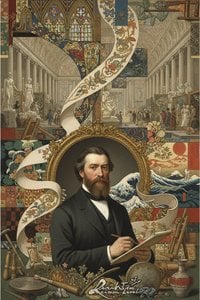
Ernest Charles Eugène Appert: The Shadow Photographer of Paris
Ernest Charles Eugène Appert (1830 – 1891) remains a figure shrouded in both fascination and controversy within the annals of 19th-century French art history. More than just a photographer, Appert was an innovator who skillfully harnessed the nascent power of photomontage to shape public perception during one of France’s most turbulent periods – the Paris Commune of 1871. His legacy isn't solely defined by his artistic output but also by the ethical dilemmas surrounding his methods and their impact on historical narrative, prompting ongoing debates about artistic integrity and the responsibility of artists to engage with social issues.
Early Life and Artistic Foundations
Born in Chartroux, France, Appert’s upbringing instilled a meticulous attention to detail—a characteristic that would prove invaluable to his photographic endeavors. He began his artistic journey as an apprentice under Émile Defonds, a prominent member of the Société Française de Photographie, alongside Alphonse Joseph Bousseton, a former miniature painter. This formative experience exposed him to both traditional painting techniques and the burgeoning discipline of photography, fostering a dual skillset that would underpin his distinctive approach. Crucially, Appert’s brother, Eugène-Léon Appert, also pursued photography, establishing a collaborative business identity that ensured their shared vision for artistic expression. The brothers' dedication to mastering both visual arts and photographic science reflected the intellectual fervor of their time—a period marked by rapid advancements in scientific observation and artistic experimentation.
Photography and Photomontage: A Revolutionary Hybrid
Appert quickly established himself as a portrait photographer of considerable renown, capturing the likenesses of influential political figures—a profession reflecting the intellectual climate of his era. He participated in the Universal Exhibitions of 1862 and 1867, showcasing his photographic prowess to a wider audience and demonstrating an eagerness to engage with contemporary artistic trends. However, Appert’s true genius lay in his pioneering use of photomontage—a technique that combined photography with graphic elements like printing and collage to create composite images designed to convey complex messages. This innovative approach allowed him to transcend the limitations of traditional representation and actively manipulate visual information for propagandistic purposes. He meticulously crafted these montages, blending photographic documentation with artistic embellishments – a deliberate strategy aimed at amplifying emotional impact and shaping viewers’ perceptions of reality. His work stands as a testament to the transformative potential of merging disparate mediums into a single powerful form of expression.
The Commune Trials: Fabrication and Propaganda
Appert’s involvement in the Paris Commune of 1871 cemented his place in history, albeit as a controversial one. Employed by the Ministry of Justice as an expert witness for the Tribunal de la Seine, he undertook extensive photographic documentation of imprisoned Communard prisoners—a task undertaken with unwavering professionalism. Yet, Appert’s most enduring contribution to the Commune narrative was arguably his series of photomontages titled “Crimes de la Commune.” These images were deliberately staged and manipulated to discredit the Communards and bolster the government's justification for repressive measures following Thiers’s ascension to power. The resulting depictions—often composites combining photographs with sketches and text—presented a skewed portrayal of events, fueling debates about artistic integrity and historical accuracy. Critics questioned Appert’s motivations and scrutinized his methods, arguing that he prioritized political expediency over objective observation – raising fundamental questions about the role of art in shaping public opinion during periods of social upheaval.
Notable Achievements and Artistic Legacy
Beyond “Crimes de la Commune,” Appert produced striking photomontages documenting the execution of Louis Rossel, Pierre Bourgeois, and Théophile Ferré at the Satory Camp – a poignant visual record of a pivotal moment in French history. These images powerfully conveyed emotion and served as testament to Appert’s ability to capture dramatic scenes with precision and artistic sensitivity. His work gained recognition internationally, appearing in prestigious museums such as the National Gallery of Canada, the Getty Museum, the Musée d'Orsay, and the Metropolitan Museum of Art. Today, reproductions of his photographs—available on WahooArt.com—continue to fascinate collectors and scholars alike, prompting ongoing discussions about the role of photography in shaping historical memory and challenging conventional interpretations of artistic expression. Appert’s legacy endures as a reminder that art can serve not only aesthetic purposes but also political agendas – a distinction that continues to provoke critical reflection on the relationship between creativity and social responsibility.