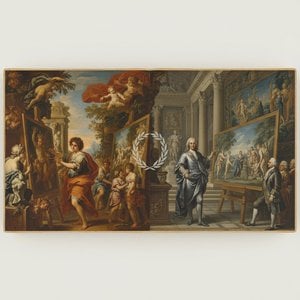
Didier Barra demeure un artiste enveloppé d'un mystère profond et captivant, sa vie n'étant qu'une suite d'ombres projetées par l'éclat remarquable de ses œuvres survivantes. Né vers 1590 dans les environs paisibles de Metz, en Lorraine—faisant alors partie du Duché de Lorraine—les premières années de Barra sont largement perdues dans les brumes du temps, laissant aux historiens le soin de reconstruire sa trajectoire à travers les coups de pinceau mêmes qu'il a laissés derrière lui. Vers 1608, il entreprit un voyage transformateur vers l'Italie, une migration qui allait fondamentalement altérer son âme artistique. En arrivant à Naples, une ville alors vibrante de l'énergie intense de l'ère baroque, Barra trouva bien plus qu'un nouveau foyer ; il trouva le canevas d'une vision qui lui était propre, mêlant la précision méticuleuse de ses racines françaises à l'intensité dramatique et émotive du paysage italien.
Visions de Déclin et Grandeur Sublime
Rencontrer un paysage de Barra, c'est pénétrer dans un monde saisi dans l'effondrement silencieux et lent du temps lui-même. Il acquit une renommée singulière pour ses vues urbaines—des visions de tours s'écroulant et de bâtiments désolés, presque stériles, qui évoquent une atmosphère troublante, presque post-apocalyptique. Sa palette était intentionnellement austère, dominée par les tons sombres de bruns sourds, d'ochres et de gris, ce qui servait à accentuer le poids psychologique de ses compositions. Grâce à une maîtrise magistrale de la perspective, Barra créa des sentinelles architecturales qui semblent à la fois puissantes et mélancoliques, invitant le spectateur à contempler l'inévitable déclin de l'effort humain. Dans des œuvres telles que Paysage avec bâtiments, on observe un jeu incroyable entre les textures tranchantes et érodées de la pierre et une brume atmosphérique douce qui suggère l'air lourd et humide de la Méditerranée. Il ne s'agissait pas de simples représentations de ruines ; c'étaient des paysages psychologiques où la grandeur du passé rencontre le silence hanté d'un monde ravagé par le temps.
L'Ombre de Monsù Desiderio
Pendant des siècles, la véritable identité de ce maître fut obscurcie par une erreur d'attribution collective. Jusqu'au milieu du XXe siècle, une grande partie de la production extraordinaire de Barra était attribuée à une figure mythique unique connue sous le nom de Monsù Desiderio. Ce n'est que grâce à une rigoureuse recherche moderne que le voile a été levé, révélant que cette "main" singulière était en réalité l'œuvre de plusieurs artistes distincts, Didier Barra s'imposant comme l'un de ses contributeurs les plus vitaux aux côtés de figures telles que François de Nomé. Cette révélation a remodelé notre compréhension de l'école napolitaine, transformant une légende unique en une tapisserie complexe de génies individuels. Aujourd'hui, Barra est célébré non seulement pour sa compétence technique, mais pour sa capacité à capturer le sublime—cette intersection terrifiante et magnifique entre l'émerveillement et l'effroi. Son héritage perdure dans la manière dont il nous a appris à regarder les ruines, non pas comme de simples débris, mais comme de profonds monuments à la nature éphémère de l'existence.
Par la rédaction de WahooArt.com
Quiz d'art
Chaque question ne comporte qu'une seule bonne réponse.
Question 1:
Où est né Didier Barra ?
Question 2:
Dans quelle ville Didier Barra a-t-il atteint une certaine renommée comme peintre ?
Question 3:
Que faisait principalement Didier Barra peinturer ?
Question 4:
À quelle année Didier Barra est-il parti Metz pour l'Italie ?
Question 5:
Didier Barra collaborait-il avec un autre artiste nommé François de Nomé.
Plongez dans l'univers somptueux du baroque ! Découvrez son histoire, comment l'intégrer à votre intérieur et les œuvres incontournables. : reproductions d'art de qualité supérieure.
Explore the dramatic world of Baroque art! Discover iconic artists like Caravaggio & Rubens, defining techniques, and its lasting impact on art history. Expert insights for collectors & enthusiasts at WahooArt.
Explore the life & art of Simon Vouet, a pivotal French Baroque painter who introduced Italian styles to France. Discover his masterpieces and lasting influence on 17th-century art.
Bonjour ! Je peux vous aider à choisir une œuvre d'art, à suivre une commande ou à répondre à vos questions sur la garantie. Comment puis-je vous aider ?