Daniel Dezeuze: Deconstructing Painting and Embracing Elemental Forms
Daniel Dezeuze (born 1942 in Alès, France) stands as a pivotal figure within the Supports/Surfaces collective—a group that fundamentally challenged conventional artistic practices during the late 1960s and early 1970s. This influential ensemble, comprised of artists like Claude Viallat, Patrick Saytour, Louis Cane, André-Pierre Arnal, Vincent Bioulès, Noêl Dolla, Jean-Pierre Pincemin, André Valensi, Marc Devade, Toni Grand, and Bernard Pagès, embarked on a radical project: to dismantle the established framework of painting itself. Their aim wasn’t merely stylistic innovation but a profound interrogation of art history and its underlying assumptions—a quest to liberate it from preconceived notions about representation and materiality.
Dezeuze's artistic journey began with studies in Spanish literature at Montpellier University, concurrently attending classes at the École Supérieure des Beaux-Arts. This dual engagement fostered an intellectual curiosity that would permeate his subsequent explorations into both language and visual art. Spending formative years abroad—primarily in Spain and Mexico—further broadened his perspective and exposed him to diverse cultural traditions, shaping his artistic sensibility. He earned his doctorate in comparative literature at the Sorbonne in Paris in 1970, cementing his scholarly grounding while simultaneously nurturing his creative impulses.
The genesis of Dezeuze’s distinctive style can be traced back to his early work of 1967—a piece that secured its place within the collection of Centre Pompidou and garnered recognition at the Guggenheim Museum as part of “Masters of the Centre Pompidou.” This seminal artwork signaled a decisive break from traditional painting techniques, prioritizing structural simplicity and geometric precision. The resulting wooden ladders—characterized by their austere elegance—became emblematic of Dezeuze’s aesthetic philosophy: an unwavering commitment to reducing artistic expression to its essential components. Simultaneously, he investigated the potential of gauze—a translucent material—to create ethereal surfaces that defied conventional notions of depth and texture.
Dezeuze's exploration into Supports/Surfaces was a watershed moment in art history. Recognizing the limitations inherent in traditional painting—its reliance on illusionistic representation and its confinement within established spatial boundaries—the collective sought to liberate artistic practice from these constraints. They achieved this goal by employing unconventional materials—wood, gauze, metal—and adopting minimalist compositional strategies—often utilizing geometric forms like squares and rectangles—to challenge viewers’ expectations and provoke contemplation about the nature of art itself. This approach aligns seamlessly with Dezeuze's broader philosophical stance: a belief that art should serve as a catalyst for intellectual inquiry and emotional resonance.
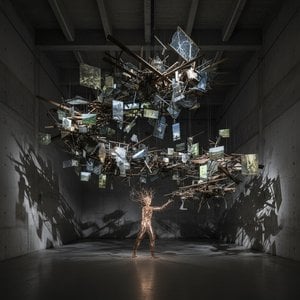
His sculptural work, too, reflects Dezeuze’s preoccupation with elemental forms and spatial relationships. Like his paintings, these sculptures eschew representational imagery—opting instead for abstract geometries—to convey profound ideas about human existence. Pieces such as “Armes et Scènes de guerre,” exhibited at Galerie Fernand Léger from 1971 until 1991, exemplify Dezeuze’s commitment to exploring the interplay between materiality and conceptual thought. The artist meticulously crafted objects from materials like metal and wood—often incorporating repetitive patterns—to create visually arresting compositions that simultaneously evoke a sense of stillness and dynamism.
Dezeuze's influence extends beyond his own artistic creations; he has actively engaged in promoting critical dialogue within the art world through his writings and publications. He founded *Peinture, cahiers théoriques* with Louis Cane and Marc Devade in 1971—a collaborative endeavor that fostered intellectual exchange and propelled critical engagement with artistic practice. His theoretical articles from this review delve into complex issues surrounding art history, psychoanalysis, and the role of language in shaping aesthetic experience—demonstrating his erudition and his unwavering dedication to advancing scholarly understanding.
Throughout his career, Dezeuze has consistently pursued a path marked by intellectual rigor and artistic innovation—a legacy that continues to inspire artists and scholars alike. His work stands as testament to the transformative power of interdisciplinary inquiry—a conviction that informs his creative endeavors and underscores his enduring significance within contemporary art culture.