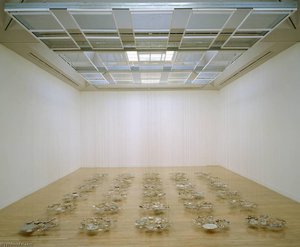
A Life Sculpted by Fragments: The World of Cornelia Parker
Cornelia Parker, born in Cheshire, England, in 1956, is an artist whose work doesn’t simply occupy space—it interrogates it. Her pieces are often born from acts of dramatic intervention, a controlled unleashing of forces that dismantle and then reassemble our perceptions of order and chaos. To understand Parker's art is to delve into a world where destruction isn’t finality, but rather a catalyst for transformation, a means of unearthing hidden narratives within the mundane and the monumental alike. Her upbringing, steeped in the echoes of 20th-century conflict – her mother a nurse during WWII, her grandfather a veteran of the Somme – subtly informs this preoccupation with fragmentation and remembrance, though Parker herself often resists direct biographical readings of her work. She received her formal training at Gloucestershire College of Art and Design, Wolverhampton Polytechnic, and ultimately earned an MFA from the University of Reading in 1982, later receiving honorary doctorates from several universities recognizing her significant contributions to the art world.
Early Influences and Artistic Formation
Parker’s artistic journey began with a resistance to easy categorization, particularly the label of “feminist artist,” though feminist ideologies subtly permeate much of her work through explorations of power dynamics and societal structures. Her initial fascination with sculpture stemmed from an early exposure to the works of Eduardo Chillida and Henry Moore, artists who championed abstraction while simultaneously engaging with materiality in profound ways. These encounters instilled in Parker a conviction that art could communicate complex ideas without resorting to representational imagery—a belief that would shape her distinctive approach throughout her career. She honed her skills at Wolverhampton Polytechnic and Reading University, immersing herself in experimental techniques and conceptual frameworks that challenged conventional artistic conventions. The influence of Minimalism and Conceptual Art is palpable in her early explorations, demonstrating a commitment to stripping away superfluous ornamentation and focusing on the fundamental qualities of materials themselves.
The Alchemy of Destruction and Rebirth
Parker’s signature style—characterized by meticulous reconstruction from fragments—represents a radical departure from traditional sculptural practices. Rather than creating objects anew, she painstakingly dismantles existing structures – buildings, furniture, even entire landscapes – subjecting them to forces like explosions, crushing, burning, and freezing before meticulously reassembling the resulting debris into evocative installations. This process isn’t merely destructive; it's fundamentally transformative. As Parker herself has articulated, “I want to make things that are haunted by their past.” Her work confronts us with uncomfortable truths about loss, decay, and the passage of time, yet simultaneously celebrates the resilience of form and the possibility of finding beauty in ruin. The resulting sculptures—often suspended in mid-air—are imbued with a palpable sense of energy and movement, mirroring the dynamic forces that shaped their origins.
Notable Achievements and Conceptual Explorations
Parker’s breakthrough came with her seminal installation *Cold Dark Matter: An Exploded View* (1991), which utilized the charred remains of a garage attacked by the British Army—a poignant symbol of urban decay and military violence—suspended in mid-air as if frozen in time. This piece cemented her reputation as one of Britain’s most innovative sculptors, establishing her aesthetic vision as rooted in confronting trauma and exploring the relationship between destruction and creation. Similarly, *Mass (Colder Darker Matter)* (1997), comprised of the charred fragments of a church destroyed by lightning—a testament to faith and vulnerability—further solidified Parker's exploration of themes related to memory and cultural heritage. Her work has garnered critical acclaim and numerous awards, including the Turner Prize in 1997, recognizing her pioneering contribution to contemporary art.
Legacy and Continuing Influence
Cornelia Parker’s artistic legacy extends far beyond her individual creations. She has inspired a generation of artists to embrace experimental techniques and conceptual frameworks—to challenge conventional notions of sculpture and installation—and to engage with complex issues surrounding identity, history, and materiality. Her willingness to confront uncomfortable truths and reimagine familiar forms has earned her enduring recognition as one of Britain’s most influential voices in the art world. Parker continues to produce compelling artwork that speaks to our anxieties about environmental degradation, social fragmentation, and the complexities of human experience—a testament to her unwavering commitment to artistic innovation and intellectual rigor.
Par la rédaction de WahooArt.com
Quiz d'art
Chaque question ne comporte qu'une seule bonne réponse.
Question 1:
Quel est le thème central de l'œuvre artistique de Cornelia Parker ?
Question 2:
Qu'est-ce que « Cold Dark Matter : Une Vue Explosée » ?', 'choices': ['Le prix Turner', 'La Biennale de Venise', 'Les Assises sanguines']
Question 3:
Parker a été nommée au prix Turner en quelle année ?
Question 4:
Quel événement historique particulier a influencé l'enfance de Parker ?
Question 5:
Quelle est une caractéristique récurrente dans la pratique artistique de Parker ?
Master the nuances of three-dimensional art with our expert guide. Explore sculptural history, from Phidias to Neoclassicism, and learn to evaluate materiality, form, and technique like a true connoisseur. Elevate your collection with profound insights into the world of sculpture.
Découvrez l'élégance intemporelle des sculptures en bronze. De la maîtrise de la fonderie d'art aux chefs-d'œuvre de Rodin, WahooArt vous guide pour sublimer vos intérieurs de prestige avec des pièces d'exception et un savoir-faire d'excellence.
Bonjour ! Je peux vous aider à choisir une œuvre d'art, à suivre une commande ou à répondre à vos questions sur la garantie. Comment puis-je vous aider ?