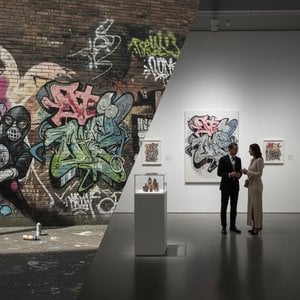
Conor Harrington : Le Pont entre Graffiti et Tradition
Conor Harrington a émergé des rues vibrantes de Cork, en Irlande, en 1980, apportant une perspective unique à l'art contemporain – une vision qui fusionne harmonieusement l'énergie rebelle du graffiti avec la discipline méticuleuse de la peinture à l'huile classique.
- Influences précoces : Le voyage artistique de Harrington a débuté à la Limerick School of Art and Design, où il a perfectionné ses compétences dans les techniques traditionnelles avant de découvrir le pouvoir transformateur du street art. Cette expérience formatrice a instauré une fascination pour la narration visuelle et pour la remise en question des normes sociétales.
- La technique de fusion : Le style emblématique de Harrington se caractérise par la superposition d'éléments de graffiti sur de vastes peintures à l'huile. Il ne se contente pas d'appliquer de la peinture aérosol sur une toile ; il bâtit méticuleusement les textures et les couleurs, faisant écho aux techniques des Maîtres Anciens tels que Rembrandt et Caravage. Cette juxtaposition délibérée crée un dialogue captivant entre spontanéité brute et savoir-faire raffiné.
- Thèmes du pouvoir et de la résistance : L'œuvre de Harrington aborde systématiquement des sujets de poids – explorant souvent l'iconographie militaire aux côtés de récits de lutte sociale. Ses murales et ses toiles dépeignent des figures confrontant l'autorité, incarnant les thèmes de la résilience et de la remise en question des hiérarchies établies. Ces images résonnent puissamment auprès d'un public aux prises avec les questions d'identité et d'engagement politique.
Expositions Notables et Reconnaissance
Le travail de Harrington a suscité un écho considérable à l'échelle internationale. Des expositions solos au Lazarides Pop-Up à New York, à The Outsiders à Londres, et au Lazarides Rathbone ont consolidé sa réputation de étoile montante au sein de la communauté du street art.
- Jonathan Levine Gallery (NYC) : Sa participation à des expositions collectives à la Jonathan Levine Gallery a mis en lumière sa polyvalence et a solidifié sa position parmi les artistes influents.
- Mead Carney Fine Art (Londres) : Ses collaborations avec Mead Carney Fine Art ont élargi ses horizons artistiques et l'ont exposé à un public plus vaste, intéressé par le réalisme contemporain.
- Daelim Museum of Contemporary Art (Séoul) : Une présentation solo au Daelim Museum of Contemporary Art a reconnu la contribution de Harrington au dialogue mondial entourant l'art et le commentaire social.
Un Dialogue Continu avec la Tradition
Malgré son implication dans le street art, Harrington reste profondément ancré dans le patrimoine artistique. Il s'engage activement avec les traditions de la peinture classique, démontrant une compréhension profonde de la théorie des couleurs, de la composition et du clair-obscur – des éléments qui élèvent son travail au-delà du simple impact visuel.
« Mon objectif est de créer des images qui provoquent la réflexion », a déclaré à plusieurs reprises Harrington. « Confronté les spectateurs à des vérités inconfortables tout en honorant simultanément l'héritage des maîtres artistiques. » Cet engagement envers la rigueur intellectuelle souligne sa signification durable en tant qu'artiste qui transcende les frontières stylistiques et s'adresse directement aux complexités de notre époque.Questions et réponses
Existe-t-il un aperçu de tous les sujets peints par Conor Harrington ?
Les œuvres de Conor Harrington peuvent être explorées par sujet sur la page Atlas thématique de l'artiste.
Où et en quelle année Conor Harrington est-il né ?
Conor Harrington est né à Cork en 1980.
Où puis-je voir les œuvres de Conor Harrington par ordre chronologique ?
Une chronologie des œuvres de Conor Harrington est disponible : la page Chronologie des œuvres classe les œuvres par date de création.