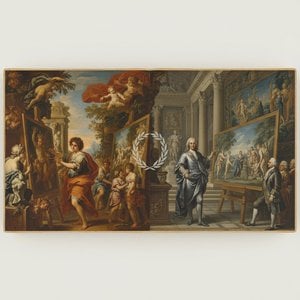
Claude Deruet : Un Maître Baroque de Nancy
Claude Deruet (1588 – 1660) s'impose comme une figure emblématique du paysage artistique de la France du XVIIe siècle, et plus particulièrement au sein de la vibrante tradition baroque émanant de Nancy. Né au sein d'une famille noble, ses années de formation furent imprégnées de mécénat artistique et nourries par un apprentissage sous l'égide de Jacques Bellange, le peintre de la cour de Charles III, Duc de Lorraine — une connexion qui façonna profondément la trajectoire de sa carrière. Cette influence précoce lui a inculqué une attention méticuleuse aux détails ainsi qu'une maîtrise magistrale de la technique, des caractéristiques qui allaient définir son héritage durable.- Jeunesse et formation : Le voyage artistique de Deruet débuta par une formation rigoureuse auprès de Bellange, lui ouvrant les portes des plus hauts échelons des cercles artistiques et l'armant de compétences inestimables dans le portrait et la peinture décorative.
- Période romaine (v. 1612 – 1619) : En quête d'un raffinement et d'une inspiration accrus, Deruet voyagea à Rome vers 1612, où il étudia avec diligence aux côtés d'Antonio Tempesta — un graveur et peintre de renom dont les innovations stylistiques résonnaient profondément avec la sensibilité de Deruet. Cette période fut marquée par la création de sa première fresque significative à la Villa Borghèse, révélant un talent émergent pour la composition dramatique et des palettes de couleurs nuancées.
- Peintures notables : Parmi les œuvres célébrées de Deruet figurent « Le Départ des Amazones » (1620) et « Le Chemin de Croix » (1620) — des scènes imprégnées de dynamisme et d'intensité émotionnelle qui témoignent de ses prouesses artistiques.
- Mécénat royal et reconnaissance : Reconnaissant le talent exceptionnel de Deruet, Charles III lui accorda la noblesse en 1621, suivi de l'accession à la chevalerie de l'Ordre de Saint-Michel en 1645 par Louis XIII — un témoignage de sa contribution au prestige culturel de la Lorraine.
Héritage et importance historique
L'héritage artistique de Claude Deruet s'étend bien au-delà de ses chefs-d'œuvre individuels — il a instauré une tradition de narration dramatique et de technique raffinée qui a profondément marqué les générations suivantes de peintres. Son travail continue d'inspirer l'admiration par sa puissance expressive et sa sophistication stylistique, lui assurant une place parmi les artistes les plus importants de l'ère baroque en France. La fascination durable pour ses représentations de samouraïs souligne l'échange culturel plus large entre l'Europe et l'Asie durant cette période — un témoignage de la vision artistique et de la curiosité intellectuelle de Deruet.Questions et réponses
Où peut-on retrouver les œuvres de Claude Deruet classées par sujet ?
L'Index thématique de Claude Deruet est une page qui répertorie les œuvres de l'artiste par thématiques.
Quel est le degré de popularité des œuvres de Claude Deruet ?
Une page Statistiques est disponible pour Claude Deruet, présentant des statistiques sur les œuvres de l'artiste sur ce site.
Puis-je parcourir les œuvres de Claude Deruet par technique ?
Les œuvres de Claude Deruet peuvent être consultées par technique sur la page Par technique de l'artiste.