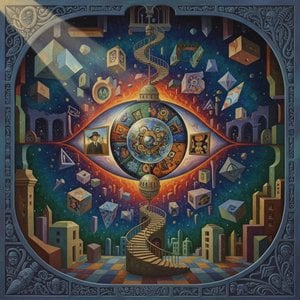
L'Architecte de l'Illusion : Le Monde Visionnaire de Chris Cran
Dans les paysages paisibles et enveloppés de brume d'Ocean Falls, en Colombie-Britannique, un voyage a commencé en 1949, lequel allait finalement mener à l'une des explorations les plus intellectuellement stimulantes de la vue dans l'art canadien contemporain. Chris Cran ne se contente pas de peindre ; il orchestre un dialogue profond entre l'œil et l'esprit. Son œuvre existe dans cet espace fascinant où la réalité commence à s'effilocher, invitant le spectateur dans un royaume où les images ne sont jamais tout à fait ce qu'elles semblent être. Rencontrer une peinture de Cran, c'est entrer dans un jeu psychologique de cache-cache, où la toile agit comme un miroir trompeur, reflétant non seulement la lumière, mais les mécanismes mêmes de la perception humaine.
L'odyssée artistique de Cran a été façonnée par une base académique rigoureuse et une rencontre intellectuelle transformative. Après avoir perfectionné son art à la Kootenay School of Art à Nelson, il s'est dirigé vers la peinture avec mention à l'Alberta College of Art and Design, dont il est sorti diplômé en 1979. Cependant, ce n'est pas un coup de pinceau qui a fondamentalement altéré sa trajectoire, mais une voix. En 1978, Cran a assisté à une conférence du redoutable critique américain Clement Greenberg. Alors que les dogmes modernistes rigides de Greenberg — qui prônaient la pureté formelle et rejetaient la complexité contextuelle — devenaient de plus en plus obsolètes, ils ont servi de catalyseur parfait pour Cran. Plutôt que de s'en tenir à ces limites établies, Cran a embrassé l'esprit bourgeonnant de la postmodernité. Il a trouvé l'inspiration dans la friction entre ce qui est vu et ce qui est connu, choisissant plutôt d'explorer le « kitsch », le contexte et les manipulations subtiles que Greenberg cherchait à exclure.
Transformer le Rien en Quelque Chose : La Maîtrise de la Technique
La marque de fabrique de la méthodologie de Cran est un concept aussi poétique qu'exigeant sur le plan technique : la capacité de « transformer le rien en quelque chose. » Cette phrase capture l'essence de son génie trompeur. Son processus implique une superposition de peinture presque méditative, où des changements subtils de ton et de texture sont utilisés pour créer des illusions d'optique qui n'émergent qu'à l'examen attentif ou lors d'un changement de perspective. Il utilise des astuces visuelles pour transformer des surfaces apparemment banales en toiles possédant une profondeur cachée, forçant le spectateur à devenir un participant actif de la création de l'image.
Ses peintures fonctionnent souvent à travers une série de glissements perceptuels :
- Ambiguïté stratifiée : L'utilisation d'applications méticuleuses de pigments pour créer des formes qui paraissent solides sous un angle, mais se dissolvent dans l'abstraction sous un autre.
- Déception visuelle : L'emploi de « tours » où l'œil est conduit à percevoir de la profondeur, du mouvement ou des formes reconnaissables qui sont en réalité le produit d'un agencement géométrique ingénieux.
- Le rôle du spectateur : La conception d'œuvres qui exigent que l'observateur bouge, plisse les yeux ou s'attarde, faisant ainsi de l'acte de regarder une performance physique et intellectuelle.
Un Héritage de Perception et de Progrès
Tout au long de sa carrière prolifique, Chris Cran est monté vers les sommets de la reconnaissance internationale, devenant l'un des peintres les plus notables du Canada de ces dernières décennies. Son travail a été célébré dans de grandes institutions, notamment la Galerie nationale du Canada, la Art Gallery of Alberta et la Southern Alberta Art Gallery. Les critiques ont souvent noté sa capacité à altérer la perception, un exploit décrit par le New York Times comme une carrière bâtie sur la délicieuse subversion des attentes. Son inclusion dans de nombreuses collections canadiennes prestigieuses témoigne de son influence durable sur le paysage de l'art contemporain.
Au-delà de la maîtrise technique de ses illusions, la signification historique de Cran réside dans son rôle de pont entre les époques. Il a pris les tensions formalistes du milieu du XXe siècle pour les infuser des sensibilités ludiques, sceptiques et multicouches de l'ère postmoderne. En mettant au défi le spectateur de questionner la formation des images, il a créé un corpus d'œuvres qui demeure éternellement pertinent dans une ère saturée de stimuli visuels. Entre les mains de Chris Cran, l'acte de voir devient un acte de découverte, garantissant que son art continue de captiver et de provoquer bien après que le premier regard se soit éloigné.
Questions et réponses
Où peut-on trouver les œuvres de Chris Cran regroupées par palette ?
La page Par palette de couleurs regroupe les œuvres de Chris Cran par palette de couleurs.
Dans quel pays Chris Cran est-il né ?
Chris Cran est né(e) en Canada.
Puis-je parcourir les œuvres de Chris Cran par ambiance ?
Les œuvres de Chris Cran peuvent être explorées par émotion sur la page L'espace des émotions de l'artiste, qui organise les créations selon l'ambiance qu'elles dégagent.