Life and Artistic Journey
Charles Wilda, born December 20, 1854, in Vienna, Austria, remains a figure shrouded in mystery—much like the ethereal beauty of his symbolist paintings. Details about his early life are scarce, leaving historians to speculate on formative experiences that shaped his artistic vision. Despite this lack of biographical information, Wilda’s contribution to the art world is undeniable, establishing him as a prominent voice within the Symbolism movement.- Early Works: Wilda's initial explorations in painting leaned towards more conventional styles, gradually embracing the core tenets of symbolism. This stylistic shift is powerfully demonstrated in “The Dreamer,” where muted colors and dreamlike imagery convey a profound preoccupation with the subconscious and the mystical—a hallmark of his evolving artistic sensibilities. (view the dreamer on WahooArt.com)
- Symbolist Landscapes: Wilda’s fascination with symbolism extended to his landscapes, transforming familiar vistas into hallucinatory representations imbued with symbolic meaning. These canvases—characterized by vibrant greens and blues—capture the alluring enigma of nature, mirroring Wilda's unwavering commitment to conveying emotion rather than mere visual accuracy. (explore symbolist landscapes on WahooArt.com)
Artistic Influences and Style
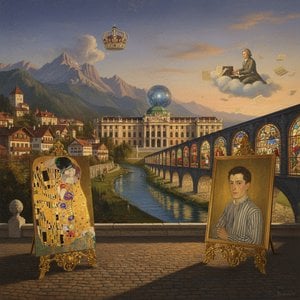
Wilda’s artistic trajectory was significantly impacted by fellow Symbolist luminaries, notably Gustav Klimt. The stylistic similarities between their works—particularly the bold use of color and prioritization of emotional expression—speak volumes about the prevailing aesthetic currents of the era. Klimt's decorative style served as a catalyst for Wilda to refine his technique and deepen his engagement with expressive art forms.- Gustav Klimt’s Influence: Klimt’s masterful manipulation of color and texture instilled in Wilda a similar approach, fostering an artistic sensibility that valued emotional resonance above photographic realism.
Symbolism Movement
Wilda's unwavering adherence to Symbolism is evident in his subject matter—often fantastical creatures, mythological beings, and abstract concepts—reflecting the movement’s desire to delve into realms beyond empirical observation. “The Enchanted Forest,” exemplifies this dedication, utilizing muted hues to evoke a sense of wonder and mystery—a deliberate choice designed to communicate profound psychological truths. (view the enchanted forest on WahooArt.com)Legacy and Availability of Works
Despite a relatively brief artistic career concluding in 1907, Charles Wilda’s impact on Symbolist art remains substantial. His evocative paintings continue to inspire admiration for their dreamlike quality and emotional depth—qualities that resonate powerfully with audiences today. Discover more about Wilda's oeuvre at WahooArt.com, where his masterpieces are presented alongside detailed biographical information and contextual analysis. (charles wilda’s page on WahooArt.com)Questions et réponses
Où et en quelle année Charles Wilda est-il né ?
Charles Wilda est né à Vienne en 1854.
D'où vient Charles Wilda ?
Charles Wilda est né(e) en Autriche.
Existe-t-il un récit chronologique de la carrière de Charles Wilda ?
La Chronologie de Charles Wilda est une frise chronologique interactive qui présente les œuvres de l'artiste par ordre chronologique, regroupées en chapitres correspondant aux différentes périodes de sa carrière.
Comment trouver des œuvres de Charles Wilda sur un thème spécifique ?
Les œuvres de Charles Wilda peuvent être explorées par mot-clé sur la page Par mots-clés de l'artiste. Chaque mot-clé regroupe les œuvres associées.
Puis-je explorer les œuvres de Charles Wilda par sujet ?
L'Atlas thématique de Charles Wilda est une page qui répertorie les œuvres de l'artiste par thématiques.
Dans quelle ville et quel pays Charles Wilda est-il/elle né(e) ?
Charles Wilda est né à Vienne, en Autriche.
Existe-t-il une chronologie des œuvres de Charles Wilda ?
La page Chronologie des œuvres de l'artiste présente les œuvres de Charles Wilda classées par date, année par année.