Early Life and Training
Charles Louis Müller (Paris 22 December 1815 – 10 January 1892 Paris), also known as Müller de Paris, was a French painter born into a family of artists—his father, Jean-Baptiste Müller, was a sculptor. From a young age, he demonstrated an exceptional talent for drawing and painting, receiving instruction from Léon Cogniet and Baron Gros at the École des Beaux-Arts in Paris, institutions renowned for fostering artistic excellence. These formative influences instilled in him a deep appreciation for classical ideals and techniques, shaping his artistic vision throughout his career.Notable Works and Achievements
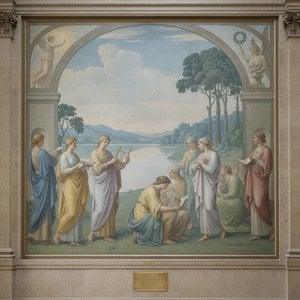
Müller’s artistic journey began with “Christmas Morning” (1837), an early painting that showcased his burgeoning skill in capturing atmospheric effects and conveying emotion. However, it was his involvement with the Gobelin Manufactory from 1850 to 1853 that cemented his reputation as a master craftsman and solidified his position within the artistic landscape of Paris. During this period, he oversaw the creation of monumental tapestries depicting historical narratives—a testament to his dedication to both artistic creativity and technical mastery. In 1864, Müller ascended to prominence when he was elected to the Académie des Beaux-Arts, succeeding Jean Hippolyte Flandrin—a prestigious honor recognizing his contributions to French art history. This appointment underscored his influence within the Parisian intellectual elite and propelled him into a role of leadership and artistic advocacy. He continued to refine his craft, producing canvases that explored themes of mythology, portraiture, and historical drama with remarkable sensitivity and precision. Among Müller’s most celebrated works are “Helio Gabalus” (1841), a dramatic depiction of the Roman emperor’s assassination—a piece imbued with theatrical grandeur and psychological depth; “Primavera” (1846)—which captures the vibrant beauty of springtime with luminous colors and meticulous detail; “Haydée” (1848)—a portrait that exemplifies Müller's ability to convey character and emotion through nuanced observation; “Lady Macbeth” (1855)—a masterpiece demonstrating his command of composition and expressive brushwork; and “Vive l’Empereur” (1855), inspired by a poem by Mérèye, commemorating the Battle of Paris—a stirring portrayal of heroism and national pride. Furthermore, Müller's artistic legacy extends beyond individual paintings. He undertook monumental fresco commissions for the Salle d’État and Galerie d’Apollon in the Louvre—institutions that stand as symbols of French cultural heritage—transforming these spaces into immersive experiences of art and history. His frescoes continue to captivate audiences with their grandeur, color palettes, and masterful storytelling.Contribution to the Louvre and Other Museums
Müller's artistic vision profoundly impacted the visual arts of his time. He was instrumental in elevating the Louvre’s artistic prestige and establishing it as a beacon of European art history. His frescoes serve as enduring reminders of the Romantic era’s fascination with mythology, grandeur, and emotional intensity—inspiring generations of artists to come.External References
* Wikipedia: Charles Louis MüllerQuestions et réponses
Quel est le degré de popularité des œuvres de Charles Louis Müller ?
La page Statistiques de Charles Louis Müller présente des statistiques calculées à partir des œuvres de l'artiste répertoriées sur ce site web.
Où se trouvent les œuvres de Charles Louis Müller regroupées par palette ?
Pour trouver des œuvres de Charles Louis Müller dans une palette spécifique, utilisez la page Par palettes de l'artiste.
Puis-je étudier l'utilisation de la couleur par Charles Louis Müller à travers l'ensemble de ses œuvres ?
Le profil chromatique des œuvres de Charles Louis Müller est présenté sur la page Génome de la palette de l'artiste.